The search for justice for the disappeared may be liked
to looking for a needle in a haystack. A high degree of patience,
perseverance and courage are some of the basic essentials.
The search for the victim is difficult enough. In most
cases, efforts yielded negative results. few are the countries where
relatives are fortunate to find their loved ones alive. Morocco is known
for cases of involuntary disappearances, where victims are found alive
after many years of being kept in secrete detention centers. In El
Salvador, the Asociacion Pro-Busqueda de Ninos Y Ninas Desaparecidos
has found alive a couple of hundreds of disappeared children - kidnapped
during the war for fear that they would take the footsteps of their rebel
parents, sold for adoption inside and outside the country and now reunited
with their biological parents. Yet, in majority of the countries of the
world, the families have never found their missing loved ones.
What makes it more difficult is the fact that the
struggle for truth, justice and redress does not end up with the search of
the physical body or human remains. The work is multi-faceted. Prior to
the actual search, organizations of families of desaparecidos are
involved in documenting cases and searching for the victims and in the
process, they empower themselves through organizing and education,
rehabilitation, projecting the phenomenon of involuntary disappearances to
the general public through solidarity, lobby and campaign at home and
abroad.
International solidarity work is the essence of the
formation of the Asian Federation Against Involuntary Disappearances (AFAD).
Learning from each other's common as well as particular situations and
their corresponding organizational responses, AFAD members are expected to
strengthen themselves through, among other things, their international
campaign and lobby. A correct combination of these components both in the
national and international levels is expected to ensure concrete fruits,
modest or grandiose they may be.
With the States' attempt to escape embarrassment before
the international community, they will certainly utilize all the powers
and resources at their disposal to perpetuate impunity. In this vein,
organizations families of the victims should all the more use all avenues
in the national and international levels in the course of fortifying
themselves.
The Value of International Lobbying
It is true that the main venue of the struggle for
justice for the disappeared is the base country. But when local remedies
have been exhausted and have proven to be inadequate, history proves that
resorting to international avenues yielded desirable results. It must be
noted, though, that international lobbying work is not only useful as a
last resort. There has to be a combination of efforts using local and
international avenues.
With the much-desired ratification of an international
treaty criminalizing enforced or involuntary disappearances, the global
struggle against involuntary disappearance surely make a dent. This is the
rationale of lobbying for the ratification of the United Nations Draft
Convention on the Protection of All Persons from Enforced or Involuntary
Disappearances.
On national legislation, we take the Philippines as an
example. The Families of Victims of Involuntary Disappearances (FIND) has
been working for almost a decade for the enactment of the bill entitled
"An Act Penalizing Enforced or Involuntary Disappearances and for Other
Purposes." FIND expects increased chances that this will be enacted
into law with the promise of President Gloria Macapagal Arryo, on August
29, 2001, the eve of the International Day of the Disappeared, to expedite
its approval.
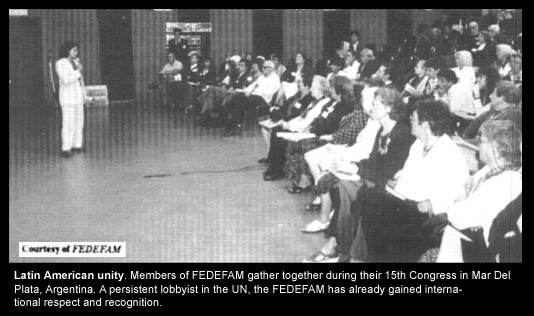
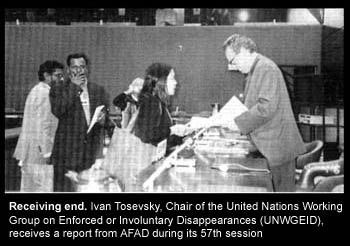 It has been 20 years since the Latin American
Federation of Associations of Relative of Disappeared Detainees (FEDEFAM)
started working for a United Nations Convention on the protection of All
Persons from Enforced or Involuntary Disappearances. Never did they know
that twenty years later, during the 57th session of the United Nations
Commission on Human Rights in Geneva, Switzerland, the latter, by an
overwhelming majority, decided on April 24, 2001 to create an inter-sessional
working group and to appoint an expert to study the draft convention.
Thirty-five countries voted in favor of the creation of an inter-sessional
working group and four countries (USA, India, Japan and Malaysia) voted
against. As to the appointment of an expert, thirty-seven countries were
in favor and five (USA, Canada, India, Japan and Malaysia) were against.
It has been 20 years since the Latin American
Federation of Associations of Relative of Disappeared Detainees (FEDEFAM)
started working for a United Nations Convention on the protection of All
Persons from Enforced or Involuntary Disappearances. Never did they know
that twenty years later, during the 57th session of the United Nations
Commission on Human Rights in Geneva, Switzerland, the latter, by an
overwhelming majority, decided on April 24, 2001 to create an inter-sessional
working group and to appoint an expert to study the draft convention.
Thirty-five countries voted in favor of the creation of an inter-sessional
working group and four countries (USA, India, Japan and Malaysia) voted
against. As to the appointment of an expert, thirty-seven countries were
in favor and five (USA, Canada, India, Japan and Malaysia) were against.
A breakthrough in the struggle against involuntary
disappearances and against impunity, this decision of the United Nations
Commission on Human Rights would not have materialized without the
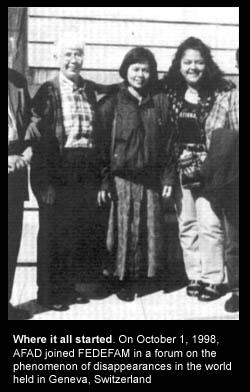
persistent and persevering efforts of FEDEFAM. AFAD, which
was established on June 4, 1998, joined FEDEFAM in oral
interventions before the United Nations Commission on Human Rights and
United Nations Working Group on Enforced or Involuntary Disappearances. It
has, to a certain extent, contributed to the modest achievements in the
international struggle against impunity. These results will certainly have
long-term effects in resolving past cases and preventing their recurrence.
 Lobbying to have laws enacted and treaties ratified to
serve our cause is not the end-all and the be-all of the struggle. But it
is an integral and indispensable part of the work. The exercise of
ratifying treaties belongs to the States, which would certainly do
what they could to escape responsibility by watering down their substance.
Knowing the urgency of the desired results, this fact could be seen as
impediment to the realization of our direction. But it has also to be
considered as a challenge. Had it not been for the efforts of NGOs, there
could have been no international treaties, which may not totally resolve
cases, but will certainly facilitate the work for the eventual
illumination of the light in this dark night of the disappeared.
Lobbying to have laws enacted and treaties ratified to
serve our cause is not the end-all and the be-all of the struggle. But it
is an integral and indispensable part of the work. The exercise of
ratifying treaties belongs to the States, which would certainly do
what they could to escape responsibility by watering down their substance.
Knowing the urgency of the desired results, this fact could be seen as
impediment to the realization of our direction. But it has also to be
considered as a challenge. Had it not been for the efforts of NGOs, there
could have been no international treaties, which may not totally resolve
cases, but will certainly facilitate the work for the eventual
illumination of the light in this dark night of the disappeared.
The Need
for an International Convention Declaring Involuntary Disappearances
as a
Crime Against Humanity
On December 18, 1992, the United Nations General
Assembly adopted without a vote the United Nations Declaration on the
Protection of All Persons from Enforced or Involuntary Disappearances.
Welcome by the human rights community as a big step in the fight against
impunity, the adoption materialized not without the indefatigable struggle
of the grandmothers, parents, brothers, sisters, sons, daughters and other
relatives of the disappeared, especially from Latin America, who pioneered
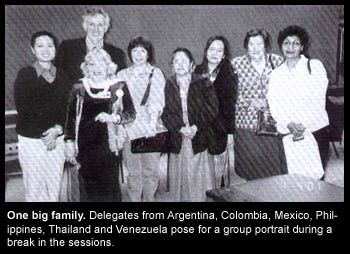
this struggle. To quote from Mrs. Martha Vasquez, FEDEFAM president
and a member of the Madres de Plaza de Mayo of Argentina, "We
started as ordinary mothers, without any knowledge about politics. Never
did we know that our struggle would reach 20 years." This
commendable perseverance is indeed, instrumental in the international
recognition, through a declaration, of what is now considered as a crime
against humanity, never permitted even in times of war.
 Yet, in international diplomacy, while a declaration
carries with it a moral value, it speaks of principles, which are
influential, but not necessarily binding. A treaty or convention is
imperative in order to enforce obligations vis-a-vis the commission of the
despicable crime of enforced or involuntary disappearances. States, bound
to protect their citizens, are obliged to abide by its provisions.
Yet, in international diplomacy, while a declaration
carries with it a moral value, it speaks of principles, which are
influential, but not necessarily binding. A treaty or convention is
imperative in order to enforce obligations vis-a-vis the commission of the
despicable crime of enforced or involuntary disappearances. States, bound
to protect their citizens, are obliged to abide by its provisions.
In the present stage of international lobbying of human
rights organizations, there is an absence of a universally applicable
treaty clearly establishing States' obligations regarding prevention,
investigation, suppression, international cooperation and guaranteeing the
right to redress. The International Covenant on Civil and Political Rights
has none of these guarantees. The Rome Statute for the establishment of
the International Criminal court does permit punishment of enforced
disappearance, but only when this is committed as apart of a generalized
attack against a civilian population or when it involves a crime against
humanity.
After a painstaking process of Latin American lawyers,
human rights defenders and experts and organizations concerned on the
issue of involuntary disappearances, the Inter-American Convention on
Involuntary Disappearance of Persons was adopted in 1994 in the city of
Belen do Para, Brazil. However, even if many of its provisions are
useful, these have limitations, such as the lack of mechanisms for
international protection conceived in its original text of 1988.
Furthermore, although open to accession by other States, the
Inter-American Convention, being a regional mechanism, could not be
applied to other parts of the world.
In the United nations Draft Convention on the
Protection of All Persons from Enforced or Involuntary Disappearances, the
crime of involuntary disappearance is addressed in a manner so
comprehensive that all its various aspects are treated. Other than this
existing draft, there is no other international instrument, except this
draft Convention, which provides obligations for prevention,
investigation, suppression and thus, protection. The inclusion of
provisions on international cooperation in Articles 4 and 8 is an added
strength to the draft and thus, is one of the many important reasons for
pursuing this. Furthermore, while the fact that children born during their
mother's captivity, sold for adoption either in their own countries may
not be generally distinct problem in Asia, being part of this
international phenomenon, this matter is given importance, as provided for
in Article 18. Article 24 gives emphasis to the right to reparation, which
comprises restitution, compensation, rehabilitation, satisfaction and
restoration of the honor and reputation of the victims. Article 13
establishes additional international protection mechanisms in the face of
the crime's extreme gravity and of its specificity and provides
international habeas corpus.
 Furthermore, the Convention has basic legal provisions
on the definition of the crime, suppression of the offense, safeguards
against impunity, measures for prevention and protection, rights of
victims and children.
Furthermore, the Convention has basic legal provisions
on the definition of the crime, suppression of the offense, safeguards
against impunity, measures for prevention and protection, rights of
victims and children.
The importance of the Convention could be seen in its
wholeness. The right to truth, particularly typical on this issue, is not
guaranteed in any other instrument. The same is true with the right to
equality before the law. Equally important is the right to mourning, of
which the recovery of the human remains is imperative.
Finally, the draft treaty responds to the international
phenomenon of involuntary disappearances as a continuing crime, which is
attributed to abuse of power that victimize the poor and thus, eliminating
or neutralizing the States' real or alleged political opponents.
With all these points elucidating the value of the
present draft, the tedious lobbying work at the United Nations, even if it
produces rather slow results, is really worth our time, energy and
resources. The fruits may not be savored by today's generation, but by the
next ones to come.
UN Member States' Response
The historic decision of the 57th session of the United
nations Commission on Human Rights (UNCHR) to create an inter-sessional
group to study the draft Convention happened not without an uphill
struggle. the initiative of the draft Convention started in 1981. After
which, the declaration was adopted in 1992 followed by the adoption in
1994 of the Inter-American Convention on Involuntary Disappearance of
Persons. It has been a couple of decades since the start of the struggle.
The said decision of the UNCHR, therefore, is a breakthrough,
indeed.
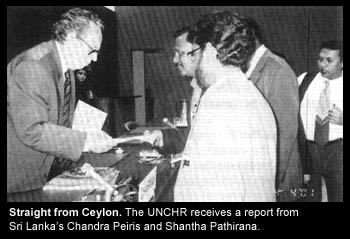
The most recent lobbying efforts of AFAD during the
57th session of the UNCHR manifested how difficult it is to convince
governments to support the draft Convention.
In 1999, the government of Sri Lanka is sued a
resolution supporting the Convention. This recognizes the government's
responsibility to respond to its huge issue of involuntary disappearances.
A couple of years later, officially, the Sri Lankan government has the
same position. Supportive of the Convention, it is the friendliest Asian
government AFAD ever met. However, in an informal meeting of AFAD
(together with FEDEFAM President Martha Vasquez) with the Sri
Lankan delegates to the United Nations in Geneva, Switzerland, the former
said that the government has the same position and does not have to
reiterate it. To the NGO community, a reiteration would have made a
difference, since it would positively influence other governments.
Furthermore, despite the government's favorable stand, the Sri Lankan
delegates in Geneva, though unofficially, questioned the need for a
Convention vis-a-vis the existence of other international mechanisms.
Moreover, they insinuated that they are suspicious of possible ulterior
motives of groups working on this issue.
The position of the delegates of the Permanent Mission
of the Philippines to the United Nations in Geneva, Mr. and Mrs. Dennis
Lepatan, is another concrete manifestation of this difficulty. yes, they
were personally very friendly to AFAD and FEDEFAM, but they posed
an ambivalent stance vis-a-vis the draft Convention. They said that
Philippine government believes that there are existing mechanisms, which
can answer this problem and that in the domestic level, there is an
anti-kidnapping law. Furthermore, they mentioned the annual appropriation,
which the government allots for the families of the victims and for the
implementation of the program of FIND. Confronted with eloquent arguments
in favor of the need for a new treaty, the Philippine delegation said the
government neither blocks nor favors the draft Convention.
Many of the Asian governments have no clear position in
favor of the draft Treaty. As a matter of fact, Japan, Malaysia and India
categorically opposed the creation of an inter-sessional group and the
appointment of an expert for this purpose. Why? Many reasons have been
said. Not wanting to be accountable for human rights violations they had
committed could, of course, not be officially admitted. Knowing the human
rights record of a number of Asian governments, we understand why
lobbying, for those who do not have what it takes, seems to be an exercise
in futility.
A number of Latin American governments, for instance,
are generally supportive of the draft Treaty. Such is a commendable sign
of their sense of history and willingness, or at least the openness to pay
for the atrocities committed by previous regimes and the resolve not to
let inhumanity happen again. This support did not come as manna from
heaven. It is a result of the perseverance, courage and determination of
the families of the disappeared, staunch human rights defenders, lawyers
and people from other fields of discipline.
What Lies Ahead of Us?
The Asian Federation Against Involuntary
Disappearances, in a meeting with the former Chairperson of the United
Nations Working Group on Enforced or Involuntary Disappearances (UNWGEID)
Mr. Ivan Tosevsky, learned that while as a body the Working Group supports
the draft Convention, Mr. Tosevsky had a contrary personal view. A former
highest official of the UNWGEID is not personally convinced of the need of
the draft Convention he is supposed to fight for. This is enough basis for
us to conclude that international lobbying, being part of the work for
truth, justice and redress, may be likened to looking for a needle in a
haystack.
A number of the member-States of the United nations,
which violated and continue to violate human rights, shall, without the
struggle on the part of the victims and the defenders, never subject
themselves to international sanction. History speaks loud and clear of how
the most notorious world dictators, like Augusto Pinochet of Chile and
Slobodan Milosevic of Yugoslavia were tried - not in the name of revenge,
but of truth, justice, redress so that the victims shall never be
forgotten and that crimes against humanity shall never be repeated.
Not without the sacrifice of those who dare to win, these victories, which
before, were beyond our imagination, would not have seen the light of day.
What lies ahead of us?
The answer largely depends on how decisive the
international community could be in turning this seemingly lonely fight to
a global struggle - that which has the strength to bring itself to its
triumphant end.
