Sri Lanka is now facing and experiencing its biggest
crisis ever since it gained independence in 1948. This crisis erupted in
1978 after then President J.R. Jawawardana introduced amendments to the
constitution without even the benefit of a consultation with the people
and people's organizations. Because of this, the functions of the
government have come to a standstill. This has severe implications for the
country's economy and has greatly affected its daily affairs. Society as a
whole has fallen into a state of uncertainty.
This was further aggravated by terrorist attacks on the
air force base and the only international airport in Katunayaka by the
Liberation Tigers of Tamil Ealam (LTTE). As a result, Sri Lanka's entire
tourism industry has collapsed and economic activity in the countryside
has been totally paralyzed. Most tourist hotels are also in the verge of
closure.
 There are also reports that children in LTTE-controlled
territories, aged 10 to 15 years, are forced to join the the rebel army.
Parents living in the said areas are beginning to secretly send their
children to government areas and settle down in seemingly "peaceful"
havens.
There are also reports that children in LTTE-controlled
territories, aged 10 to 15 years, are forced to join the the rebel army.
Parents living in the said areas are beginning to secretly send their
children to government areas and settle down in seemingly "peaceful"
havens.
However, their suffering does not end there; for most of
these children are subsequently arrested by the Sri Lankan authorities as
being LTTE sympathizers conniving with the insurgents. These innocent
children, therefore, start their lives with problems and misery, and with
the future becoming bleak and gloomy.
But while LTTE activity is concentrated in the northern
part of the island, the southern portion of the country is equally bad as
well. With 60,000 cases of disappearances, the Sri Lankan government has
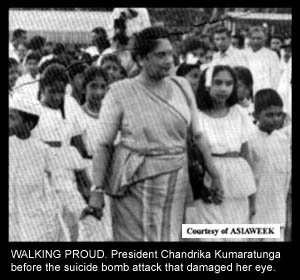
appointed four commissions to probe the matter. Then President Chandrika
Kumaratunga divided the country into three sections geographically and
created separate commissions for each. These were:
1. Western Sabaragamuwa and the Southern provinces;
2. North Central, and
3. the North and Eastern provinces.
Subsequently, one commission was created in 1998 and
functioned until the following year that exercised investigative power
throughout the country.
People had very high hopes on these commissions, believing
that they would be able to identify the perpetrators and bring them court.
The people also expected that government would soon make the necessary
steps in providing welfare and rehabilitation to the victims and their
families who are facing severe hardships and economic dislocation.
Unfortunately, all these hopes came to naught.
During the four-year period that these commissions were in
existence, no legal action was done by the authorities and the work that
they undertook proved to be sluggish and cumbersome. While they have
identified 3,000 suspected perpetrators, the commissions have no authority
whatsoever to pursue criminal complaints. They were only mandated to
submit their reports to the Office of the Attorney General. Though the
latter has already filed charges against 583 possible perpetrators out of
the 3,000 suspects, hearings are still on going.
Neither were they able to publish the full extent of their
findings and whatever report they made had very limited copies. There were
even rumors that the commissions were not totally free form political
interference, especially from security personnel who made all efforts to
obstruct the investigations.
 This condition is further exacerbated by the failure of
the Sri Lankan government to implement the recommendations and findings of
the commissions. It has also withheld the granting of compensation to the
victims' families and other intended benefits. More so, both the
present and previous administrations have ignored the proposal of the
United Nations to appoint a permanent independent commission on
disappearances.
This condition is further exacerbated by the failure of
the Sri Lankan government to implement the recommendations and findings of
the commissions. It has also withheld the granting of compensation to the
victims' families and other intended benefits. More so, both the
present and previous administrations have ignored the proposal of the
United Nations to appoint a permanent independent commission on
disappearances.
It is in this background that we commemorated the
International Day of the Disappeared. An occasion to honor our beloved
desaparecidos, it has also come to symbolize our longing for peace in
our conflict-ridden land. It is in this context that we are advancing
these demands:
1. To probe all cases involving involuntary disappearances
and those who are found guilty must be dealt with accordingly;
2. To compensate the dependants or family members of the disappeared; and
3. To give top priority to family members of the disappeared in terms of
employment and in granting of subsistence or subsidies.
Our only hope is that with the commemoration of the
International Day of the Disappeared, a breakthrough is in the offing and
justice will finally be done.