"all the words that I utter,
And all the words that I write
Must spread out their wings untiring
And never rest in their flight
Till they come where your sad, sad heart is."
(William Butler Yeats)
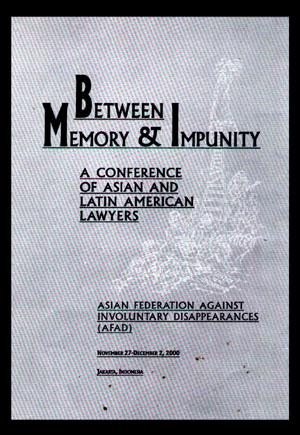 This book on enforced and involuntary disappearances
has a rare virtue, indeed. All its words, concepts and analyses dissecting
this cruel phenomenon of our contemporary world as practiced in Asia, are
really focused. Following the poet's observation, with an extraordinary
message of hope, it goes to the heart of the families of victims and
society at large.
This book on enforced and involuntary disappearances
has a rare virtue, indeed. All its words, concepts and analyses dissecting
this cruel phenomenon of our contemporary world as practiced in Asia, are
really focused. Following the poet's observation, with an extraordinary
message of hope, it goes to the heart of the families of victims and
society at large.
The AFAD seminar held in Indonesia (2000) also
highlighted the different legal and judiciary measures adopted by some
Latin American countries such as Chile and Argentina over recent years
that have battled with significant success against some of the
consequences of that repressive practice which, according to the Latin
American Federation of Relatives of Disappeared Detainees (FEDEFAM),
has occasioned over 100,000 victims on this continent alone. And that is
most encouraging. Major steps have been taken in the areas of truth,
justice, redress and prevention, which are thoroughly explained by experts
in the book. These have yet to be fully reciprocated at the international
level but the United Nations Human Rights Commission's recent decision to
create an inter-sessional body that would study the Draft Convention on
the Protection of All Persons from Enforced or Involuntary Disappearances
certainly shows a more determined approach by the international community
to outlaw this veritable scourge of humanity.
A closer definition of enforced disappearances, its
characteristic as an ongoing crime and crime against humanity, the
practice of universal justice, the affirmation of the right to identity of
child victims and the right to truth and redress of the families are the
new weapons in the struggle against the perpetrators which have been
developed by lawyers and judiciary working hand in had with families,
their associations and human rights movement in general. The Asian seminar
sets the foundations for further cooperation between family associations
and Asian legal community, which will undoubtedly bear more fruit in
combating the practice in the near future.
I am convinced that much remains to be done to create
greater awareness about involuntary disappearances and their horrifying
consequences for the victim and his/her family and friends. Perpetrators
try to carry out a perfect crime by taking the victim away, leaving
absolutely no traces and submitting him or her to intolerable suffering
before clandestinely murdering the victim and disposing of the body. No
accountability is given, authorities prefer to turn a blind eye, and
oftentimes perpetrators take advantage of public states of political
turmoil to carry out the practice under the facade of national security.
And the international community is still slow in responding. Thereby,
terror breeds in society.
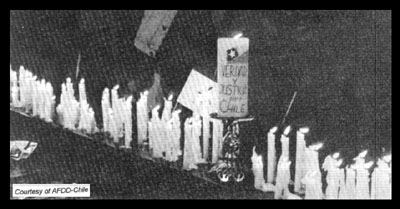 It has been to the credit especially of the families of
the disappeared to have created public awareness about the practice and
their insistence, even many decades after the disappearances have taken
place. it is the best guarantee for further progress towards its
eradication. However the challenge has yet to be resolved of impeding the
occurrence of new cases. The campaign against disappearances has a large
agenda on hand and much more support is needed to be successful. The
publication of this book therefore, cannot have had been more timely.
It has been to the credit especially of the families of
the disappeared to have created public awareness about the practice and
their insistence, even many decades after the disappearances have taken
place. it is the best guarantee for further progress towards its
eradication. However the challenge has yet to be resolved of impeding the
occurrence of new cases. The campaign against disappearances has a large
agenda on hand and much more support is needed to be successful. The
publication of this book therefore, cannot have had been more timely.
Then again the events of September 11th particularly in
New York, many thousands of people were literally killed and
disappeared in an instance by a terrorist act, give a new twist to the
subject and similarities are to be found. The anguish of the relatives
there in the despairing search for their loved ones is fully understood by
the relatives of the desaparecidos in empathy with the suffering of
those American families. The commitment to truth, justice, solidarity and
human rights, which the movements the families of the disappeared so
eloquently display, whether in Asia or Latin America, must be
inspirational also for those families in New York. We have always
characterized the practice as a clear expression of terrorism which can
never be condoned in any of its forms be it by the state or by private
groups. Hopefully then, we can all come together in the pursuit of
justice, truth and redress so as to guarantee that these situations never
repeat themselves again. The only effective solution is the strengthening
of the international framework of law so that all perpetrators can be
punished. War has proven itself to be no solution in the past as new
injuries and injustices are committed and the spiral of violence continues
to spin out of control. And we can only lament that their pain is being
invoked for justifying war. Sooner or later, world public opinion will
convince itself that the full observance of international human rights is
the only way forward for humanity and certainly the Indonesian seminar
marks a milestone for Asia on that road.
A final tribute for AFAD members in verses from
Shakespeare's Sonnet No. 55 seems most appropriate:
When wasteful war shall statues overturn,
And broils root out the work of masonry,
Nor Mars his sword nor war's quick fire shall burn
The living record of your memory.
'Gainst death and all-oblivious enmity
Shall you pace forth; your praise shall still find room
Even in the eyes of all posterity ......
I do believe that generations to come will so tribute
the families, but that homage can only be completed when human rights
standards are fully applied everywhere. We are all invited by AFAD to make
that journey together.
