"Is all the world just jails and churches?"
Rage Against the Machine
Judging form the latest newspaper headlines, its seems that Manila's
bustling liberal press is once again in a frenzied state of glee. With the
impeachment trial of former President Estrada long consigned to the
caravan of history and with the drama and staccato of EDSA II and III
transformed into a mere speck of outdated memory, practitioners in the
Philippine media have finally found a suitable replacement for the
controversy that has to be embroiled former super cop and newly elected
Senator Panfilo "Ping" Lacson . Accused by communist
guerilla-turned-military intelligence chief Col. Victor Corpus of
"laundering" an estimated amount of $211 million in illegal money in
various banks in the United States, Canada and Hong Kong, this former
mistah and reputed crimebuster of the Marcos and Estrada periods
is now on the defensive - a role which is not apt to his liking given his
previous position in the country's security hierarchy.
 Further fuel was added to the imbroglio when Corpus and
his men pinpointed Lacson as the mastermind behind the several cases of
human rights violations, the most prominent of which was the
"disappearance" of PR consultant Salvador "Bubby" Dacer on November 24,
2000. Abducted presumably by the elements of the Philippine National
Police and The President Anti-Organized Crime Task Force (PAOCTF) thirteen
days prior to the opening of the impeachment proceedings, Dacer had
allegedly in his keeping damning pieces of evidence that might have
resulted in Estrada's conviction and removal from office plus his
connivance with the emerging United Opposition.
Further fuel was added to the imbroglio when Corpus and
his men pinpointed Lacson as the mastermind behind the several cases of
human rights violations, the most prominent of which was the
"disappearance" of PR consultant Salvador "Bubby" Dacer on November 24,
2000. Abducted presumably by the elements of the Philippine National
Police and The President Anti-Organized Crime Task Force (PAOCTF) thirteen
days prior to the opening of the impeachment proceedings, Dacer had
allegedly in his keeping damning pieces of evidence that might have
resulted in Estrada's conviction and removal from office plus his
connivance with the emerging United Opposition.
But some may laud Corpus' expose' as daring , and even
novel, in a magic-realist country like the Philippines, human rights
groups are not thoroughly impressed. For even his appointment as PNP Chief
Director General, Lacson was rumored to be one of the most notorious
torturers during the Martial Law regime and a trusted henchman of the
former dictator. If common knowledge in the NGO grapevine is to be
believed, he might as well be the one responsible for the 1985
"disappearance" of Redemptorist priest Fr. Rudy Romano in Labangon, Cebu -
a case which remains unsolved until today. Pundits believe that among
favorite methods of killing is by placing his victims inside steel drums
to be buried underground or thrown to the sea.
However, what principally worries activists about
Lacson, most of all, are not his previous cases of human rights abuses but
the fact the a man, with such a reputation, was able to get a seat in the
highly prestigious Senate. With his sordid misdeeds as an open secrete,
observers believe that Filipinos have already grown accustomed to having
leaders that trample on human rights, perpetuating the culture of death,
injustice and impunity.
Sordid Statistics
The extent of disappearances has been so pervasive that
since the first reported case was documented in 1971, reports are still
being received by human rights NGOs until today. The Families of Victims
of Involuntary Disappearance (FIND), for example, has recorded 1,717 cases
of enforced disappearances since the time before before the imposition of
Martial law until the second quarter of 2001. From this number, 759 were
reported under Marcos while 820 were surprisingly reported under his
democratic successor Corazon Aquino. 81 cases were subsequently reported
during the incumbency of former General Fidel Ramos, 56 cases under Joseph
Estrada's two-year presidency and 1 case under the current administration.
Unfortunately, out of this total number, only 1,437 cases have been
properly documented and verified, thus excluding the "problematic" 280
from the UN rolls and other institutional list.
According to studies, most of these atrocities were
committed by the military, the Army particularly, followed by the police
and the various vigilante and paramilitary groups.
 While statistics show a decreasing trend in the
reported cases, all are not sanguine as they seem. the Estrada regime, for
instance, already had 56 cases before it could even reach the three-year
half mark - a number that might have exceeded his predecessor if Erap was
allowed to finish the remainder of his term.
While statistics show a decreasing trend in the
reported cases, all are not sanguine as they seem. the Estrada regime, for
instance, already had 56 cases before it could even reach the three-year
half mark - a number that might have exceeded his predecessor if Erap was
allowed to finish the remainder of his term.
On May 4, 2001 103 days after Arroyo's assumption to
the presidency, Marcelino Prochina, a resident of Sta. Josefa, Agusan del
Sur was arrested by members of the military while on his was to a house of
a friend to watch television. An alleged member of the communist New
People's Army (NPA), Prochina was apprehended without informing him of his
rights and without notifying his relatives that the former was in their
custody. According to his narration, he was taken to a safe house located
in the Palm Oil plantation and held incommunicado for three days.
Though he was releases on May 7 after a near-frantic search by his family
and pressure from the radio station DXBR, his life, Prochina states, is no
longer the same.
Despite these alarming numbers and experiences, the
Philippine government , however, seems fully insulted from any possible
concern or apprehension. As matter stand, State investigators have been
working (or what amounts to it) at snail pace, turning the justice
campaign into a protracted legal battle.
 Even today, not a single case has been resolved and the
government has not given proper reparation and indemnification to the
victims and their families. While half-hearted effort were made by the
government to assuage the victims, they mostly remained publicity gimmicks
with no long-lasting effect.
Even today, not a single case has been resolved and the
government has not given proper reparation and indemnification to the
victims and their families. While half-hearted effort were made by the
government to assuage the victims, they mostly remained publicity gimmicks
with no long-lasting effect.
On February 3, 1993, then President Ramos signed
Memorandum Order NO. 88 forming the President Task Force on Involuntary
Missing Persons- a huge super body composed of various government agencies
with FIND invited as the eighth member. Mandated to investigate all
cases of involuntary disappearance and with the Philippine Commission on
Human Rights (CHR) as the lead agency, the Task Force, however, came to
naught due to the inclusion of the Armed Forces of the Philippines (AFP)
and the Philippine National Police (PNP) in the Task Force - two of the
agencies reputed to be the most notorious violators of human rights.
Enter FIND
Perhaps, it is also this sense of frustration that
prompted several families to form FIND on November 23, 1985 - three months
before Marcos' fall from power in February the following year. Founded by
eight families, the organization soon developed into a national mass
organization with nine chapters located in the major provinces of the
country. Formed through the help of Task Force Detainees of the
Philippines (TFDP) which is under the auspices of the Association of Major
religious Superiors of the Philippines (AMRSP), FIND has since become one
of the most vocal advocates of human rights in the Philippines and an
ever-present lobbyist at both the national and international levels.
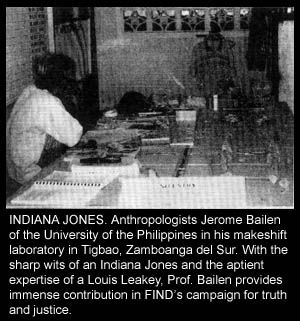
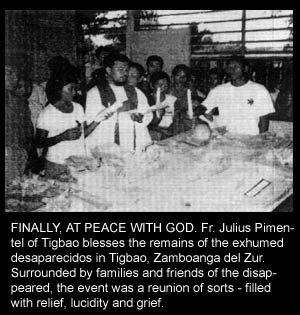
It has also, since 1995, conducted various exhumation
missions in the countryside to identify and recover the remains of the
missing. The most recent of these missions was done in April-May of this
year, in the town of Tigbao, Zamboanga del Sur. A rustic town seventeen
kilometers away from the provincial capital of Pagadian, Tigbao used to be
a nestle-ground for communist insurgents during the 1980s, a fact that
prompted the military to send the Military Police (MPs) to the Area. A
composite force of Army and Constabulary personnel, the MPs were task to
break the backbone of rebellion and bring peace to the town at whatever
cost.
By all indications, it seems that the MPs executed
their directives with flying colors and gloated glee, turning the town
from a notorious rebel stronghold in the early 80s into a howling
wilderness by 1987. In between, the MPs not only pitted themselves against
the New People's Army but also arrested suspected rebel members and
sympathizers, using both sticks and bayonets and strong-arm tactics. By
the late 1980s, the MPs were so successful that not only were the
guerillas totally defeated, but even the civilian population was cowed to
submission through campaigns of terror, intimidation and abduction.
Driven primarily by fanaticism and anti-communist
hysteria, the armed confrontation between insurgents and government troops
soon came to involve defenseless civilians, with the military securing the
success of the pacification campaign by liquidating the very residents
they were sworn to protect. In Barangay Poblacion alone, thirty
(30) victims are said to be buried in the grounds of Tigbao Central
School, which was formerly used as company headquarters of the Military
Police. During an exhumation conducted in April this year, FIND was able
to discover seven sets of remains, two of them headless, in the said site.
Confirmed as victims of involuntary disappearance, they were first
tortured before they were finally executed by the MPs, with sharply
torn shirts and nylon cords tied around their necks. There were even
instances where the graves were later used as garbage pits by the
military, with the remains just barely a few meters beneath the pile of
army rubbish and maggot-infested debris.
The brutality of the MPs had no bounds that even wild
and backyard animals became mere playthings for the MPs. If town-rumor and
folk-knowledge are to be believed, intoxicated MPs would hunt more monkeys
in the night and use them as dart boards, with their jungle knives in lieu
of the actual darts.
One of the informants, who was a five-year old boy back
then, recalled how he saw a victim hanging form a mango tree by the wrists
with his ears severed and his eyes scooped out. This incident strengthened
the belief among the town folk that human eyes were used as alternatives to
"ice" during the booze sessions of the MPs, offering this strange
concoction to any local official who happen to pass by.
The hanged victim, according to the witness, was later
murdered together with another desaparecido. one of the victims was
later identified as Dominador Barias, a brother of one of the volunteers
in the exhumation mission. Aside from Barias, the other victim who was
identified were Charito Cabungcag and Serafin Albia.
During FIND's exhumation sortie in Tigbao, remains were
also recovered in the adjoining barangays of Tuburan and Lacupayan.
In the first site, two graves were discovered 80 meters apart from each
other and which were later identified as the burial place of Celedonio
Mondido and Eliceo Orbeta.
In Lacupayan, three other skeletal remains were found,
one of which yielded an incomplete set of bones. The two complete sets
were identified as belonging to Robert Tobiano and Germiniano Plutuniano
while the other is still unidentified up to this time.
Believing in the twin notions of self-management and
self-help, the organization has taken an even more provocative instance in
its justice campaign. To address the government's seeming lack of
commitment to prosecute the alleged perpetrators, FIND has assumed the
task of filling test cases in Mindanao.
The Practice
The former refers to the abduction and murder of Jose
Sumapad, a farmer from the southern province of Zamboanga del Sur.
Kidnnaped and totured by members of the Sagrado Corazon Senor, or
more popularly known as Tadtad (Chop), Sumapad's remains were later
exhumed and positively identified through a FIND mission in 1996. though
an earlier lawsuit was filled by the victim's wife Editha in June 1986,
the case was later withdrawn due to threats and intimidations from the
defendants.
It was re-filed 12 years later by Jose, Emiiano's
brother, after two witnesses, Serafin Cortes and Felipe Amucay named all
those involved in the killing - Roberto Perpetua, Loloy Agom and Reynaldo
Veroza - all of whom are now in hiding. According to reports, the
witnesses were persuaded to testify in court due to the promptings of the
victim's daughter who was the wife of Cortes. Marked as Case No. 5276 and
now being heard before the sala of Judge Almida, the case is being handled
by Atty. Fausto Lingatin.
Another was the disappearance and the murder of several
Subanen tribesmen from Dumingag, Zamboanga del Sur. An
indigenous groups that has the tradition of supporting (but not actually
joining) the NPA, they have long earned the ire of the military and the
various militia groups that they helped formed.
On February 1, 1981, a dozen of their tribesmen were
arrested by the militia Civilian Home defense Force (CHDF) after an
encounter with the NPS that resulted in the death of their commander
Gornez. They were brought to Baranagay Guintananan where they were
tactically interrogated and tortured. Reports state that the slain
commander's wife and daughter (who was then 10 years old) also took part
in the torture, hacking the three of them with bolos. Two of the victims'
ears were even cut and eaten fresh by their captors. All of them were
later shot and buried in unknown location.
In December 1997, FIND was able to exhume and identify
all the remains which led to the current case. Two years later, 12
separate cases were filed in the Regional Trial Court of Molave, Zamboanga
del Sur, with Atty. Lingatin as FIND's legal consul. Marked as Criminal
Nos. 2000-2010, 1113 to 2000, the cases were filed before the sala of
Judge Camilo Tamin. While suspect Tranquilino Gornez is already in policed
custody and has subsequently admitted the crime, two other suspects remain
at large.
The third case involves the abduction of six workers of
the Paper Industries Corporation of the Philippines (PICOP) on October 14,
2000. Apprehended by Corporal Rodrigo Billiones at Barangay Sta. Maria,
Trento, Agusan de Sur, the victims were later brought to the headquarters
of the 62nd Infantry Battalion of the Philippine Army.
On November 13, FIND's legal counsel Atty. Leon
Montilla, Jr. filed for the writ of habeas corpus and lodged a
complaint against Corporal Billiones, citing "serious illegal detention"
and "kidnapping." The said case is already at Branch 6 of the Regioanl
Trial Court of Prosperidad, Agusan del Sur under the auspices of Judge
Patricio Balete. the suspect was also recently detained and is now in the
custody of his commanding officer Capt. Eduardo Monjardin. A possible
witness was already agreed to testify, further adding weight to the
arguments of the prosecution.
In all these cases, the Catholic Church has
consistently showed its support to FIND and the families, most especially
in ensuring the security of the relatives and the witnesses. Material,
moral and financial support was also given by various support networks and
local government units (LGUs) one of which is the facilitation of new
witnesses.
Acting Locally, Thinking Globally
A few days after the opening of the 12th Congress, the
rep. Krisel Lagman-Luistro filed House Bill No. 1913 entitled "A Bill
Penalizing Enforced of Involuntary Disappearance". A measure which the
organization has been lobbying for the past half-decade, it intends to
prevent the further occurrence of this phenomenon and rebuild a society
based on justice and human rights.
FIND has also organized the "Manila Lawyers' Conference
on Disappearance and Impunity" last May 27-June 2, with the theme "Can
Justice Reign Under Gloria Macapagal-Arroyo (GMA)?" Attended by 40 lawyers
and legal practitioners from major provinces of the Philippines, the event
was the first echo activity of the Asian and Latin American Lawyers'
Meeting in Jakarta, Indonesia and intends to widen the organization's
network of lawyers who would eventually assist the families in their fight
against impunity and injustice.
Seeing the need for more "horizontal" linkages with
kindred formations in the Asian region, FIND also played a significant
role in the formation of the Asian Federation Against Involuntary
Disappearances (AFAD) which had its Founding Congress in May of last year.
Envisioned to further strengthen the struggle in the continent, the
Federation now boast of five member organizations from Indonesia, Kashmir
(India), the Philippines, Sri Lanka and Thailand. It also has prospective
members from China, Pakistan and Manipur.
FIND also made its presence felt internationally
through its recent participation in the 57th session of the United Nations
Commission on Human Rights (UN-CHR) last April in Geneva, Switzerland. In
the joint intervention with the Latin American Federation of Associations
of Relatives of Disappeared Detainees (FEDEFAM), FIND presented the
situation in the country and sought the assistance of the international
community in addressing this problem.
Quo Vadis, GMA?
Yet while the families remain ever hopeful of their
future prospects, it seems that severe difficulties will be felt in the
medium-term. In her first State of the Nation Address last July 23,
President Arroyo delivered, what pundits dubbed as the most "promising"
speech that was ever made on such an occasion. Promising, not because of
its sanguine statistics or impeccable logic, but the sheer volume of
promises that she made - from improving the country's agriculture to
building a public school in every barangay (village), and from
alleviating the poverty incidence level to turning the Philippines into
the region's Information Technology capital.
What was apparent, however, was the total absence of
nay policy direction regarding human rights. While the President made
mention of the need of "modernizing" the armed forces and the police, she
did not raise the equally important aspect of "humanizing" these twin
institutions. it seems that with her hold on power still unstable, Arroyo
has opted to gain the support of the largely oppositional poor and
developed closer links with the military to preserve her own authority.
But with rumors of coups and countercoups as the
persistent issue in the capital, Arroyo may have no other option but to
cling to whatever alliance that may come her way. One can only that in the
succeeding three years, the President will not be totally impervious to
grassroots pressure and civil society engagement. After all, she was the
one who pledged, in her inaugural speech eight months ago, that she would
usher a new kind of politics based on good governance, transparency and
human rights.
Let us hope that she remembers that pledge before it is
too late.