"Much more than speeches and conferences, we need, in
the field of human rights, action and devotion; and even more than
philosophers, lawyers or ministers, we need militants."
What twelve years ago was said by prominent
French lawyer and Minister Robert Badinter as a homage to the role of the
human rights NGOs in helping society achieve progress, AFAD and FIND
members have already understood and experienced. But their experience also
shows that they also need lawyers, philosophers and ministers to move
forward in their cause. Because the victims of involuntary disappearance
and their families are regularly engaged in legal battles, and sometimes
even "legal vacuum", they particularly need lawyers, and probably, a
particular group of lawyers: militant lawyers.
First Echo Activity of the Jakarta Conference
The Asian and Latin American Lawyers' Conference
Against Involuntary Disappearances (Jakarta, Indonesia; November 27 -
December 2, 2000) was an occasion of fruitful exchange of experiences and
knowledge. AFAD and the Asian lawyers present at the Conference suggested
organizing similar conferences at the national level, so that more
lawyers would get informed about the international law instruments
concerning involuntary disappearance. With the Lawyers' Conference on
Disappearance and Impunity in Manila as the first echo activity of the
Jakarta Conference, AFAD and FIND attempted to bring to the Philippines
not only the information but also the enthusiasm that was shared by the
lawyers present in Jakarta.
 Indeed, these "echo activities" afford each member -
organization an opportunity to go back to its own particularities and
priorities, in the light of experience and exchange during the Jakarta
Conference. It is the time for the invited lawyers to learn more about
international instruments and the experience of others, to use all these
to have new ideas to overcome the legal difficulties the families of the
disappeared are facing in their respective countries. It is the time for
militant activists and lawyers (usually they are only a few) to invite
other lawyers to be also militant - in the sense of being dedicated to a
cause and ready to use experience and knowledge for this cause.
Indeed, these "echo activities" afford each member -
organization an opportunity to go back to its own particularities and
priorities, in the light of experience and exchange during the Jakarta
Conference. It is the time for the invited lawyers to learn more about
international instruments and the experience of others, to use all these
to have new ideas to overcome the legal difficulties the families of the
disappeared are facing in their respective countries. It is the time for
militant activists and lawyers (usually they are only a few) to invite
other lawyers to be also militant - in the sense of being dedicated to a
cause and ready to use experience and knowledge for this cause.
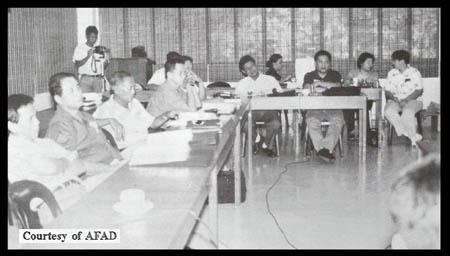
It was in the calm and green environment of Ateneo de
Manila University in Quezon City that the Manila Conference took place for
a week, from Monday (May 28) to Friday (June 1, 2001). Around 20 lawyers
from different regions of the Philippines were invited, coming from Manila
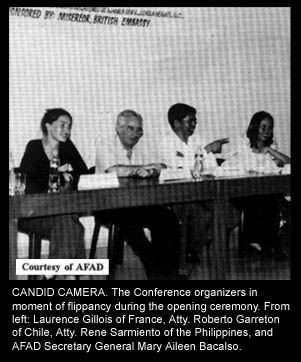
and the major provinces in Luzon, Visayas and Mindanao. Atty. Roberto
Garreton was invited to share with the Philippine lawyers his experience
in Chile and the Latin American experience in combating involuntary
disappearance. Some of the Philippine lawyers who attended the conference
in Jakarta presented the topics which were previously discussed in
Jakarta.
Wanted: Militant Lawyers!
On the very first day of the Conference itself, before
presentation or discussion on law instruments actually began, the
delegates already realized the extent of involuntary disappearance in the
Philippines.
Together in the same conference room were
representatives from the diplomatic corps, the various national government
institutions, the lawyers and families of the disappeared. Atty. Roberto
Garreton presented the situation in Latin America regarding impunity and
involuntary disappearance. Numerous Latin American countries are now in
the process of investigating perpetrators of past human rights abuses. It
is a very long process, full of disappointments but also some victories.
Its a long process which was made possible by the systematic and precise
work of NGOs and lawyers together with the families of the victims. In
Asia, involuntary disappearances also widely occurred in the past, but are
continuing in some regions, such as in Kashmir in India, Aceh in
Indonesia, and in the Philippines with the very recent case in Agusan del
Sur (May 4, 2001). The common difficulty faced by Asian NGOs fighting for
the recognition of the truth is the lack of political will form the
government to facilitate the fight against impunity. Asia does not have
regional human rights instrument yet and the national instruments are
often very poor, if not non-existent.
However, there are some positive initiatives such as
the efforts towards the enactment of an ASEAN Human Rights Mechanism. In
the Philippines, the National Institute for Policy Studies (NIPS) is
working with the Philippine Human Rights Commission (CHR) for the
enactment of the said mechanism. Other similar initiatives are being
undertaken by NGOs in Indonesia, Malaysia and Singapore. These are
positive initiatives that hopefully would prosper.
After an overview of the Latin American and Asian
experiences regarding involuntary disappearances, there was a focus on the
Philippines Situation. SAD (Samahan ng mga Anak ng Desaparecidos /
Association of the Children of the Disappeared) members 10 to 20 years
old, dressed in black, white and dark green performed, acting out their
dreams and their nightmares. The children of the disappeared shared,
through strong words and gestures, the pain and anguish which are in their
minds and hearts. They brought with them the personal objects of their
disappeared relatives: a scarf, a notebook, a small piece of material, a
piece of wood, a book - all are preciously kept.
People between 20 to 70 years old - the wives,
fathers, mothers, sons and daughters of the disappeared - talked about
their own harrowing experiences.
"He left to buy something... The military came and said
they have to interrogate him... he was accused of being a communist... I
know who denounced him... I was not there when he disappeared, my wife
went to see him in jail, I came later, but they were saying, he is not
there anymore you cannot see him, but after insisting, several days after,
we saw him with several marks of torture on his body. It is terrible to
see your child like that. After that we never saw him again... I studied
law. I became a lawyer to be able, one day, to bring to court those
responsible of the disappearance of my Father."
Through their presence, the families of the
disappeared, who where invited by FIND for the opening day of the
Conference, showed the necessity for the Philippines to have adequate
response to their cause. Through their movements and their gestures, the
children of the disappeared told us that the future of the Philippines is
also dependent on how their country will recon with its past and its
present. through their words, the families made it clear that they need a
judicial answer as part of society's recognition, and that, in this
regard, much is expected from the lawyers.
The message is clear: wanted militant lawyers! But the
conference also aims at improving the knowledge of the participants on
various international and national law instruments regarding involuntary
disappearance. of course, not only militant but competent lawyers are also
needed.
Outcome of the Conference
Among the lawyers present, some were already familiar with human
rights law and international instruments more particularly those regarding
involuntary disappearance. For others, however, these were all very new.
This Conference was then a very good occasion for them to know about FIND
and AFAD. When Daisy Valerio presented FIND and AFAD's campaign against
involuntary disappearance. the lawyers sincerely shared their lack of
familiarity with the work of these two organizations, as well as the issue
of involuntary disappearance in their country. The debates were thus, less
precise as expected but at the end of the day, they were nonetheless
fruitful and helpful.
 The discussion with the lawyers, as member of
Philippine society and not necessarily as various human rights advocates,
showed how important it is to touch the whole society. For many reasons,
only few Filipinos were aware about the tragic fate of their compatriots
who are victims of involuntary disappearance during the past and even in
the present time. Involuntary Disappearances, as well as any other form of
human rights violations, should not only be a concern of an individual or
a group of individuals but also of the whole society. it is also part of
the work of the human rights NGOs, including the associations of the
families of the disappeared, to make their concern a societal concern.
The discussion with the lawyers, as member of
Philippine society and not necessarily as various human rights advocates,
showed how important it is to touch the whole society. For many reasons,
only few Filipinos were aware about the tragic fate of their compatriots
who are victims of involuntary disappearance during the past and even in
the present time. Involuntary Disappearances, as well as any other form of
human rights violations, should not only be a concern of an individual or
a group of individuals but also of the whole society. it is also part of
the work of the human rights NGOs, including the associations of the
families of the disappeared, to make their concern a societal concern.
The media plays a vital role in making the fight
against involuntary disappearance and impunity a societal concern . In
countries were the media is more or less free, they become one of the key
partners of NGOs. During the Conference, FIND showed its strong capacity
to be of interest to the media. Several newspapers, two TV programs, and
two radio stations covered the event. One of the TV program showed some of
the pictures of the disappeared. These very short seconds of appearance of
the disappeared on the TV screens were not only a deep moment of emotion
for their families but were also signs of small victory against
forgetting. Forgetting does not help society to progress.
During the week-long conference, topics that were
previously discussed in Jakarta were again raised, such as the Latin
American Experience on Disappearance and Impunity. the UN
Declaration on the Protection of All Persons from Enforced Disappearances,
the Rome Statue for the Establishment of the International Criminal Court,
the Inter-American Convention on the Involuntary Disappearances of
Persons. However, other topics focused on Philippine reality. The lawyers
discussed for instance the draft Bill Penalizing Disappearances that is
about to be re-filed in the Congress. The bill was filed in 1995 and 1998,
during the 10th and 11th Congress respectively, but it never managed to go
beyond the committee level.
The bill clearly established that the crime of
involuntary disappearance is a continuing crime and shall not have any
time limit for prosecution. The bill also established a system of
reparation and rehabilitation for the victims and their families. After
the presentation of the draft Bill by FIND Auditor Jose Marie Faustino,
the lawyers had an interesting debate on the conformity of such a law to
the principle of non-retroactivity and to the Philippine Constitution.
They suggested some modifications which would be taken into account by
FIND for the debates in Congress. The lawyers prepared a statement, in
which they explained the current situation regarding involuntary
disappearance in the Philippines, and presented their recommendations.
Two very positive meetings with the Philippine
authorities marked the last day of the Conference. A delegation of lawyers
and FIND members met Undersecretary Maria Merciditas Guitierez of the
Department of Justice and Supreme Court Chief Justice Hilario Davide. Ms.
Guitierez was particularly interested in obtaining the data and
information from FIND to seek a solution for the pending cases. She
informed the lawyers that the President Arroyo has decided to re-activate
the Presidential Human Rights Committee (PCHC) which she will now
head. Chief Justice Davide, who had a leading role in the impeachment
process against former President Joseph Estrada, advised FIND to gain
public support by transforming their personal concern into a public
concern and by making this concern as a progressive stride for the
Philippines as a whole. He was also responsive to the question of creating
ad hoc tribunals to solve the cases still pending in court. It is
now the work of FIND and the families, with the help of lawyers, to
prepare the cases and file the necessary lawsuits.
The final salvo, the solidarity night, was an other
occasion to discuss with the families and come up with the succeeding
steps. The children from SAD again had a very touching theatrical
performance expressing the experience of a child of a disappeared faced
with the questions on the whereabouts of his father. The night was
enriched by a very entertaining game. Everyone joined the round,
youngsters, elders, FIND members and lawyers. They formed a circle where
some wool balls were distributed. Everyone had to throw to the others a
wool ball in keeping the beginning of the wool ball, and very soon a net
was formed - a network. A ball was then thrown in the middle and it
was everyone's responsibility not to let it fall down. A very touching
symbol of solidarity and coordination. This image should help the lawyers
to become of remain militant, even in the most difficult and challenging
moments.