The Association of Parents of Disappeared Persons (APDP)
was founded in 1994, when after the outbreak of conflict, a large number
of enforced or involuntary disappearances started taking place in Jammu
and Kashmir. A group of relatives of missing persons then began collective
action against the phenomenon of disappearance, which was unknown in the
region before 1989. Since its formation, more and more relatives have
joined the Association and after consistent struggle, they were able to
project disappearances as one of the most serious issues in Kashmir. At
present, APDP is campaigning for (1) the end of this inhuman practice
which is permissible even in times of war; (2) the repeal of all impunity
laws and bringing the perpetrators to justice; and (3) indemnification for
all victims of disappearances.
APDP is one of the founding members of AFAD (Asian
Federation Against Involuntary Disappearances) which was established in
Manila, Philippines in June 1998. Together, the APDP members promotes
justice and human rights advocacy along with other AFAD
member-organizations in Indonesia, Thailand, Sri Lanka and the
Philippines.
After interacting with similar organizations in Asia
and Latin America, especially with the Latin American Federation of
Associations of Relatives of Disappeared Detainees (FEDEFAM) which has
been fighting against enforced disappearances for the past 20 years, APDP
decide to build a memorial in honor of all the missing persons. Memorials
have been erected for people who were killed during protests or
demonstrations which then became an emotional sanctum and a place of
consolation both for the victims and their families. Such edifices have
been built in many places in almost all countries, and they have been used
to symbolize their people's commitment to new and more humane values. the
words of Mojapelo about the Thokaza monument in South Africa are a good
example:
"Through this monument, we have a simple message for future generations
and the rest of the world: never, never again will we allow our community
to bleed this way."
These memorials are symbols of new hope and new life in
their communities. Tthey serve as a break between the past and the future.
They help the communities in their journey of self-definition. They also
evoke the good and the bad at the same time. They remind the communities
about the troubled past and comfort them by placing their hope in the
future.
In contrast with other monuments, the memorial that
APDP is envisioning is more urgently needed because relatives are deprived
of graves and they have no place where they can vent their feelings and
sadness for their loved ones. Relatives of victims of extra-judicial
executions or custodial deaths have at least the thousands of graves to
provide them some solace; they can also offer fateha to them. The
memorials that were constructed in Latin America and various countries in
Asia to remember those who involuntary disappeared are healthy examples.
Perhaps the sentiments of the families were best
expressed in a solidarity statement written by AFAD before the formal
foundation-laying, "this artistic piece of metal and stone shall be an
ironic indictment against the cruelty of the State and the callousness of
the perpetrators and a living testimony to the bravery of the Kashimiris
and the martyrdom of the victims."
The document further states that, "until the day of
final reckoning arrives, we can only hope that the monument would gather
beneath its feet all those who have lost a husband, a friend, or a son,
all in the name of political power and greed. For lest the authorities
forget, the landmark in all its solid impartiality, would remind the world
that their collective grief-turned courage is written in blood and
immortalized in stone."
In Kashmir, the Association, and the relatives
themselves, feel a similar need. APDP fears that between 4,000 to 5,000
people between the age group 17-40 with some exceptionally old and very
young persons have disappeared. These were mostly carried out by
operatives of law-enforcement agencies who were armed with draconian laws
like the Armed Forces (Special Powers) Act that provides impunity to these
perpetrators in their campaign against militancy. Impunity is also a major
factor behind the perpetration of crimes against humanity.
In Kashmir, the relatives of the missing number
more than 100,000, including the widows and the thousands of children.
They are deprived of the graves of their beloved, including the rituals,
which provide relief to the relatives. The families are confused. Though
most of them have accepted the possible "death" of their loved ones, a
number of them still refuse to accept their deaths until and unless their
bodies are found. The majority of the families are desperately in need of
a memorial where they could visit and pay respect to their missing kin and
pray for them.
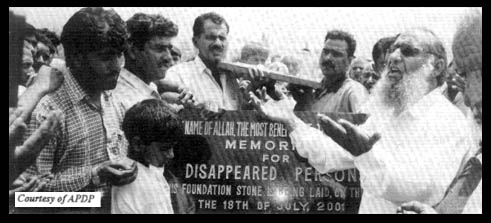
The decision to raise the monument was done in January
2000 with APDP approaching the various artists, architects and sculptors
in the Kashmir valley for assistance. A number of professionals also
expressed their willingness to provide their expertise and both civil
society and the business community gave their support to the idea.
It was decided that the monument would be a
non-figurative structure bearing all the names of the missing persons. A
library would also be built beside the monument wherein valuable
information on the missing persons will be kept.
The final model that was prepared was based on a
traditional dome structure. It features a grand flight of stairs which
would take one to a raised platform with 20-feet high blank walls
separated at their projected meeting point by an arched entrance gateway.
It opens to the balcony that would present a direct overview of the whole
complex. The physical access to the interior of the complex is by a narrow
staircase which leads down to the center of the memorial.
Planners intend to construct the memorial near Igdah in
the heart of Srinagar. Though APDP at first wanted to raise it in a
private land, the Association, however, does not have the means to
purchase such land. Hence, the Association's Executive Committee decide to
build it in an area adjacent to Shaheed Graveyard.
We must neither allow the past to be forgotten nor
should we allow it to happen again in future generations. The justice we
seek lies not in forgetting the past but in remembering those who should
never be forgotten. And the planned monument in Kashmir is but an initial
step towards that goal.