Twenty Years On, Asia Still Waits
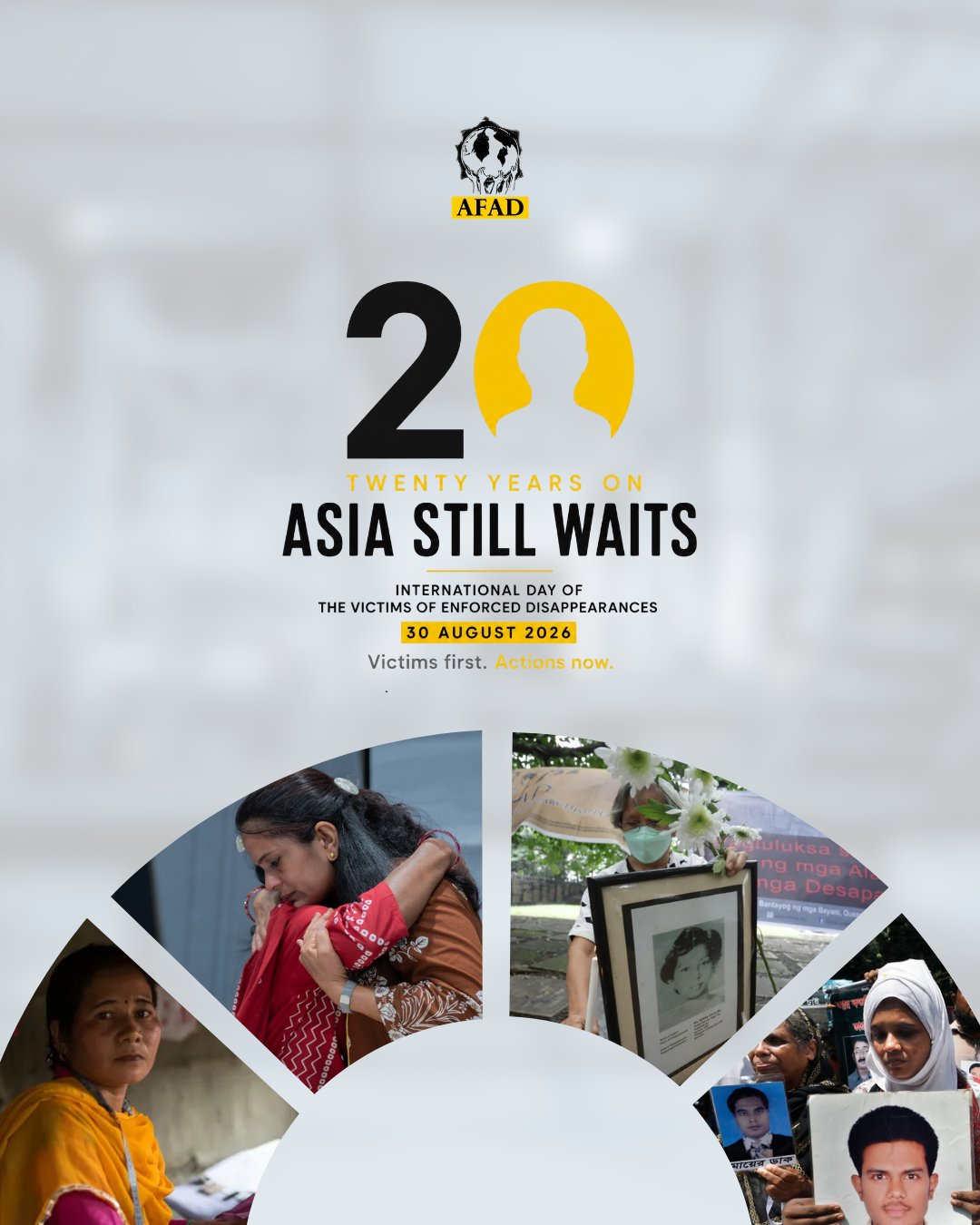
AFAD Statement for the International Day of the Victims of Enforced Disappearances
30 August 2026
Every 30 August, the world marks the International Day of the Victims of Enforced Disappearances. This year, the date sits inside a larger one. On 20 December 2006, the UN General Assembly adopted the International Convention for the Protection of All Persons from Enforced Disappearance. The Committee on Enforced Disappearances is marking the twentieth anniversary through CED20, under one line: Victims first. Action now.
For the Asian Federation Against Involuntary Disappearances (AFAD) and our member organisations, the anniversary arrives with a harder number attached. Asia has the lowest rate of ratification of any region in the world, and it has held that position for twenty years. Twenty years on, Asia still waits.
The Convention was demanded, drafted and won by families. AFAD sat in every session of the UN Working Group that elaborated the treaty between 2003 and 2006, carrying Asian testimony into a process the world had assumed belonged to Latin America. When the consensus text was presented in Geneva in September 2005, AFAD dedicated the victory to the desaparecidos of the world. Twenty years later, the region whose families helped write this treaty remains the region least protected by it.
Seventy-eight of the 193 UN Member States are party to the Convention. Of the fifty-five states in the UN Asia Pacific group, twelve have joined. Africa sits near thirty-five percent and the remaining regions near fifty. Asia is the outlier.
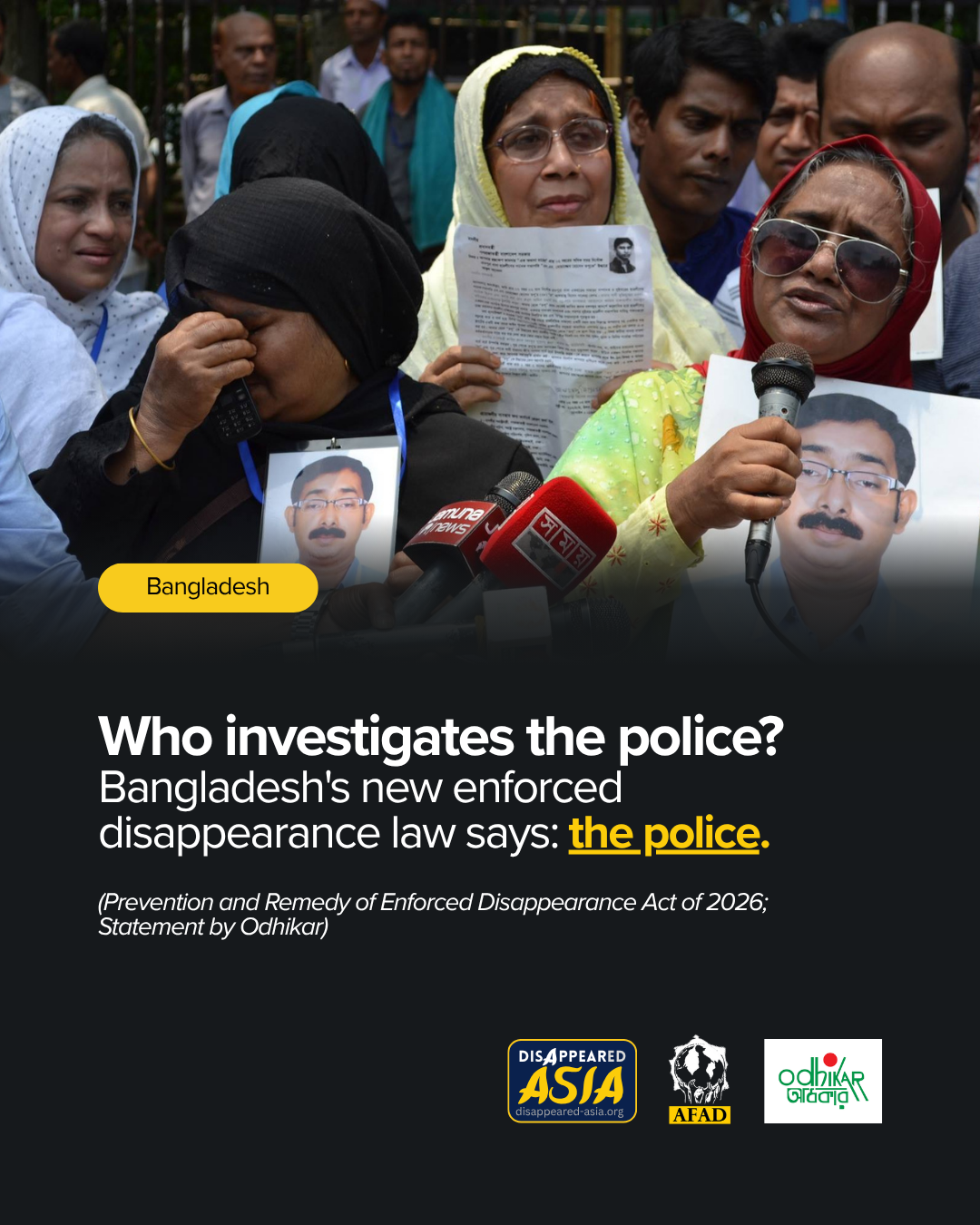
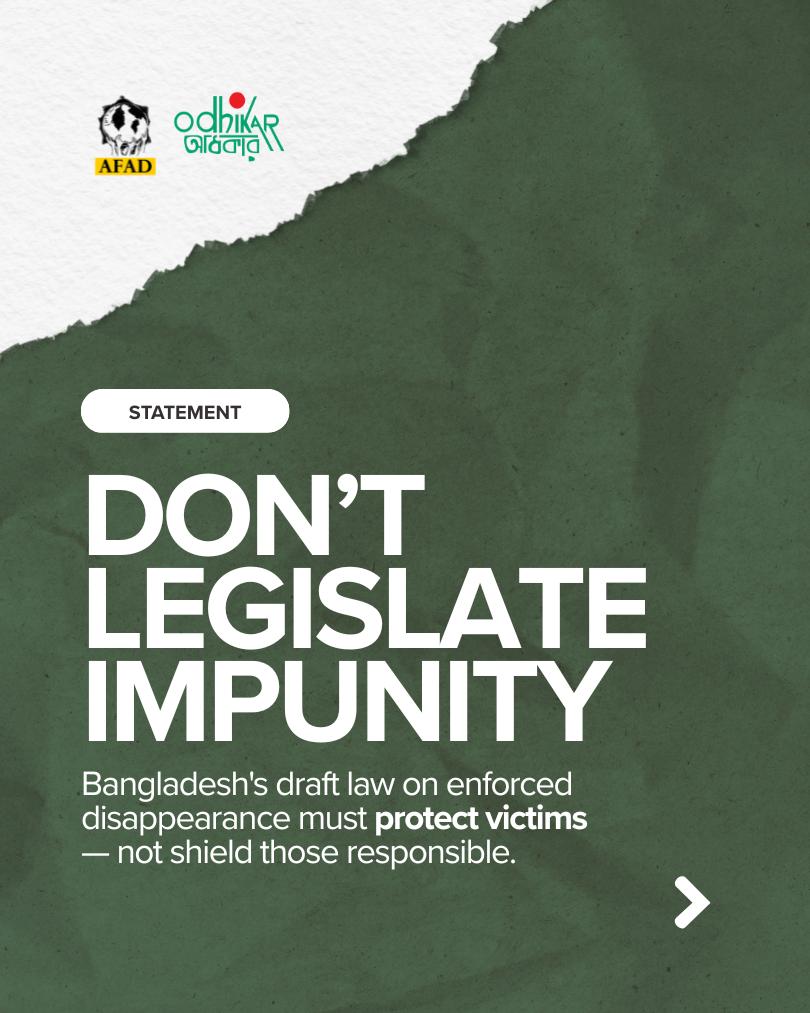
The detail is worse than the total. In Southeast Asia, only Cambodia and Thailand have joined. Indonesia signed in 2010 and Laos in 2008; neither has ratified. Beyond the subregion, India signed in 2007 and has never ratified either. Nepal, Pakistan, Timor-Leste and the Philippines have neither signed nor ratified. Ratification is also not the finish line. Sri Lanka ratified in 2016 and criminalised enforced disappearance in domestic law in 2018. Eight years on, the UN Human Rights Office finds that tangible progress towards resolving individual cases remains limited. Bangladesh acceded in 2024 and established a Commission of Inquiry into enforced disappearances the same year. Its law criminalising the practice remains a draft: accession without a statute is a promissory note.
Only thirty of the seventy-eight States parties have recognised the Committee's competence to receive individual complaints under Article 31. The declaration costs nothing and requires no new law; it is a signed paper deposited with the Secretary-General. Yet in the other forty-eight States parties, the Committee cannot examine a family's complaint, no matter how strong the case. The government is bound by the treaty, but the family has no way to knock on the Committee's door.
What non-ratification means is concrete. Outside the Convention, a family has no right to request urgent action under Article 30, no reporting cycle before the Committee, no treaty definition of victim that includes them, and no legal hook for the search obligations of Article 24. They are left with the Working Group's humanitarian mandate: indispensable, but non-binding. And the gap is widening at the worst possible moment. The international human rights system is under sustained strain, with funding shortfalls, postponed treaty body reviews, and governments openly questioning whether multilateral obligations bind them at all. When the architecture itself is under attack, the states standing outside it are not neutral. Every year of non-ratification is a year in which enforced disappearance in Asia remains, legally, nobody's business but the perpetrator's.
Enforced disappearance is not a single event in the past. It is a continuing crime that reshapes a family across generations. It moves into the household, and it is overwhelmingly women who carry it. Women are held in a legal status the law does not name, suspended between married and widowed, unable to access inheritance, property, guardianship, or a bank account without first declaring a husband dead. Families lose a breadwinner and then lose more, because desperation exposes them to fraud and to people who target their property. Letters are censored, and calls are wiretapped. Stigma crosses every border, whether a woman is called a bad omen, a half widow, or is blamed for a relative's politics.
What We Ask of States
• Ratify or accede where this is still pending, which in our region means most states. To India, Indonesia and Laos, which signed and then stopped: finish what you started. To the Philippines, which wrote Asia's first anti-disappearance law in Republic Act No. 10353 and then declined to bind itself internationally: ratification is the missing half of that law. To Nepal, Pakistan, Timor-Leste, and every state that has done neither: twenty years is not deliberation; it is refusal. Sign, ratify, and incorporate the Convention into domestic law.
• Search for, locate, and release the disappeared, and where they have died, identify and return the remains, as Article 24(3) requires. Resource forensic and DNA capacity, protect and excavate suspected burial sites including unmarked graves, and involve families at every stage.
• End the enforced silence. Stop the surveillance, censorship and intimidation of victim families, and protect the right of women defenders to speak and organise without reprisal.
Twenty Years On
The Convention works when states let it. Since the urgent action procedure became operational in 2012, 546 cases have been closed after the disappeared person was located, 427 of them alive. Those are people who came home because a mechanism existed and someone used it.
Twenty years is long enough for Asia to have built a different record. AFAD will keep bringing this region's families to the Committee, to the Working Group and to every government still outside this Convention. We owe that persistence to those who drafted this Convention with us and did not live to see it ratified in their own countries. We owe it most of all to the disappeared themselves, and to the society they dreamed of and were taken for dreaming.
Victims first. Action now. Twenty years on, Asia still waits, and we are not waiting quietly.
Download official document here: Download official document (PDF)