Who investigates the police? Bangladesh's new law says: the police

Who investigates the police? Bangladesh's new law says: the police
Odhikar's Concerns Regarding the Prevention and Remedies for Enforced Disappearance Act, 2026 Approved by the Cabinet
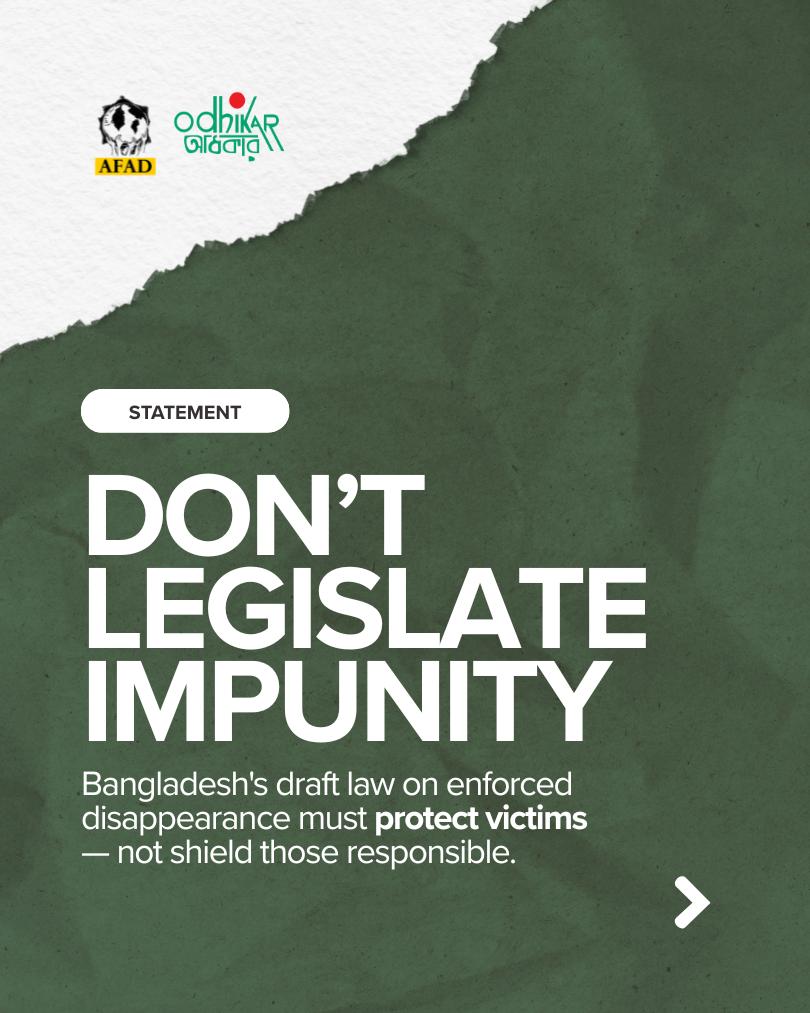
Yesterday, on 3 August, the Cabinet approved the Prevention and Remedies for Enforced Disappearance Act, 2026. Under Section 14 of the Act, the authority to investigate complaints of enforced disappearance filed against law enforcement agencies, has been assigned to the police. This is concerning. Based on Bangladesh's experience, it can be stated with confidence that police investigations into allegations of enforced disappearance against the law enforcement agencies, cannot be impartial or fair. As a result, such perpetraters may continue to enjoy impunity.
Furthermore, under Section 21 of the Act, if a court determines that the complaint is false, the complainant may face up to five years of rigorous imprisonment. This provision is likely to further entrench impunity and place victims and their families at even greater risk.
It is worth noting that during the rule of the ousted Sheikh Hasina government, the police refused to even accept General Diary (GD) entries from families of victims of enforced disappearance. Moreover, even two years after the fall of the Hasina government, under the current BNP–run administration, when Miraj Sheikh was subjected to enforced disappearance in April 2026, instead of accepting and preparing a GD for enforced disappearance, the police compelled the family to file the information as a missing person complaint.
It should also be recalled that the Enforced Disappearance (Prevention and Remedies) Ordinance 2025, promulgated during the tenure of the interim government, had assigned the responsibility for investigating such cases to the National Human Rights Commission.
During the Sheikh Hasina-led Awami League regime, many leaders, activists, and supporters of the current ruling party (BNP) were themselves victims of enforced disappearance and extrajudicial killings. However, following the February 2026 Parliamentary elections, the newly elected BNP government let the Enforced Disappearance (Prevention and Remedies) Ordinance 2025 lapse, instead of passing it as an Act. The government drafted and approved of a new Prevention and Remedies for Enforced Disappearance Act, 2026 in the Cabinet, that does not contain many of the checks and balances in the Ordinance of 2025. Consequently, this weakened law has raised significant concern among victims of enforced disappearance, their families, and human rights defenders.
Odhikar believes that the authority to investigate allegations of enforced disappearance should be directly vested either in an independent National Human Rights Commission or in a dedicated Commission of Inquiry on Enforced Disappearances, and out of the realm of the police/law enforcement. This should be explicitly incorporated into the law. Odhikar therefore calls upon the government to amend the draft Act accordingly before it is passed by Parliament.
Download official document: https://i0pclidzx8z439hf.public.blob.vercel-storage.com/documents/odhikar-august-2026-ed-law-protest.pdf
Issued by: Odhikar Team
Download official document here: Download official document (PDF)