Don't legislate impunity
Bangladesh must heed the UN experts: enact a law that protects the disappeared, not one that shields impunity.
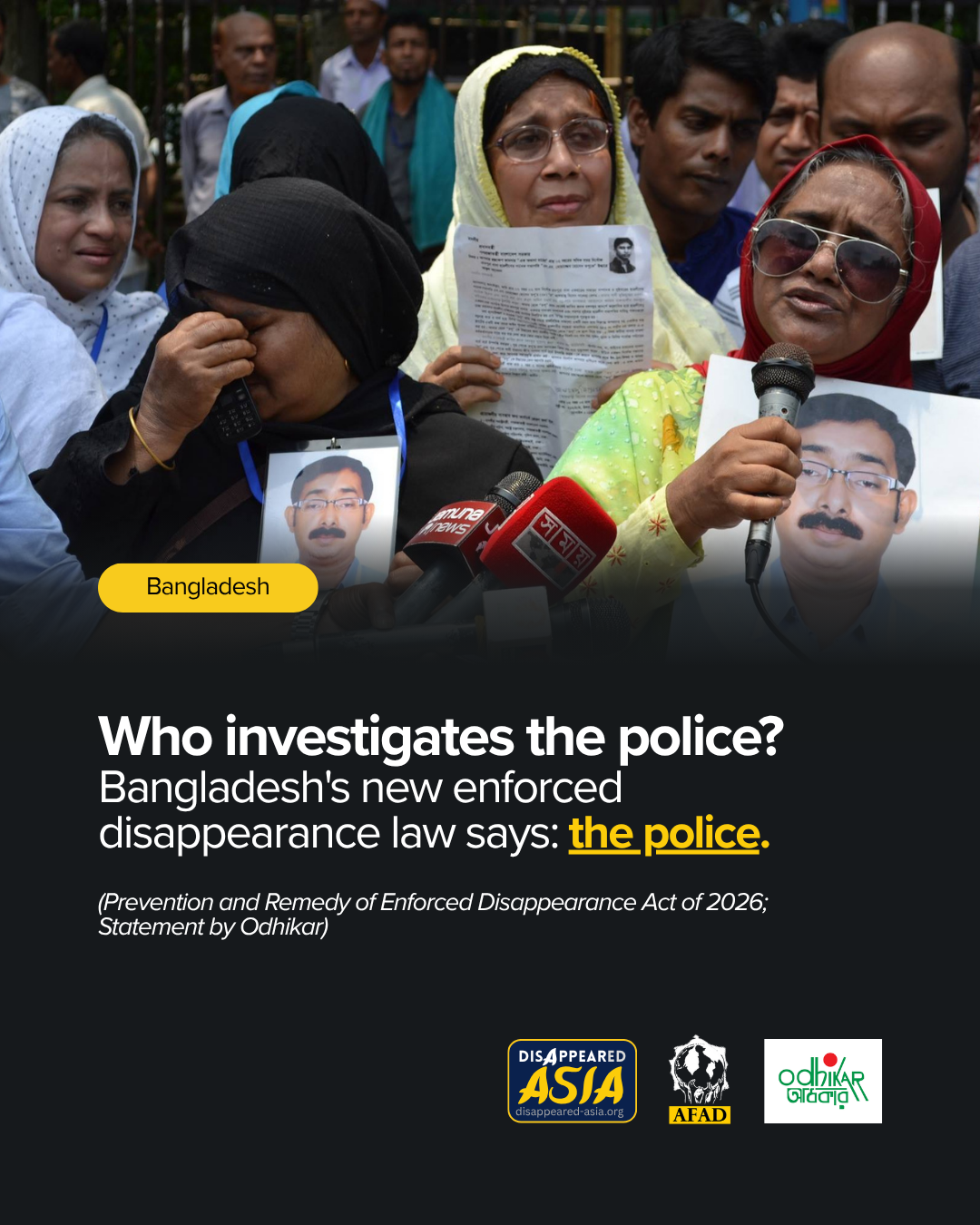
The Asian Federation Against Involuntary Disappearances (AFAD) welcomes the joint communication issued on 17 June 2026 by four United Nations human rights mechanisms—the Working Group on Enforced or Involuntary Disappearances, the Working Group on Arbitrary Detention, the Special Rapporteur on extrajudicial, summary or arbitrary executions, and the Special Rapporteur on the promotion of truth, justice, reparation and guarantees of non-recurrence—concerning the draft bill "Prevention and Remedy of Enforced Disappearance Act, 2026." We endorse the experts' analysis in full and call upon the Government of Bangladesh to act on it without delay.
AFAD speaks in solidarity with the families of the disappeared in Bangladesh, and through our member-organisation Odhikar, which has documented and accompanied victims of enforced disappearance in Bangladesh since 2010. This is not a technical dispute over legislative drafting. It is a question of whether Bangladesh, having acceded to the International Convention for the Protection of All Persons from Enforced Disappearance, will keep the promise of the July 2024 uprising and respect the ICPPED, or legislate impunity into permanence.
A historic opening that is now at risk
For fifteen years, enforced disappearance was an instrument of State repression in Bangladesh. The Commission of Inquiry on Enforced Disappearances, established by the Interim Government, documented over 1,600 cases and found the Rapid Action Battalion, the police and intelligence agencies systematically responsible, with 251 persons still missing and their fate unknown. These findings, of incommunicado detention, falsified arrest records, deliberate inter-agency transfers to diffuse accountability, and cross-border renditions, are precisely the structural realities against which any new law must be measured.
Yet the legislative response has gone backwards. The Enforced Disappearance Prevention and Remedy Ordinance, 2025, together with the National Human Rights Commission Ordinance, 2025, instruments that for the first time criminalised enforced disappearance and empowered an independent commission to investigate the security forces, were allowed to lapse following the February 2026 general election. The draft now before Parliament is, as a broad coalition of national and international organisations has warned, a diluted version of what came before. The UN experts' communication confirms, point by point, that the draft falls short of Bangladesh's binding obligations.
The defects the experts identify are not minor:
• National Security: Section 4 would exclude from the definition any arrest followed by production before a magistrate within the constitutional time limit—even where the fact of arrest, the whereabouts, or the condition of the person are concealed in the interim. The prohibition of enforced disappearance is absolute and nonderogable; no temporal, security-based or exceptional limitation is permissible.
• Capital Punishment: AFAD opposes capital punishment in all circumstances. Its inclusion in Section 6 is incompatible with the rights to truth and to an effective remedy, and is especially indefensible where the Commission itself documented the systematic destruction and falsification of evidence.
• Unequal Command Responsibility: Sections 10 and 11 set a higher threshold to prosecute civilian superiors than military ones. Enforced disappearance in Bangladesh was a chain-of-command crime; any gap in superior responsibility is a gap engineered for impunity.
��� No Statute of Limitations: The draft's silence on imprescriptibility and its disjunctive treatment of the continuing offence are inconsistent with the cumulative and continuous nature of the crime.
• Missing Protections: The bill fails to bar military and special courts, conflates the search for the disappeared with criminal investigation, and reduces reparation to discretionary fines—falling short of the comprehensive framework the Convention requires. The draft offers no safeguard for released survivors against continued criminalisation, no child-specific provisions, and no gender-sensitive approach.
Recognition, reparation, and an end to reprisals
Families in Bangladesh continue to be denied the most basic recognition. Without official acknowledgement of a disappearance, relatives cannot operate bank accounts, settle property, or claim assistance—a daily injustice. Meanwhile, survivors who have returned face fresh harassment through fabricated cases, and other forms of unlawful State violence persist. These realities make plain why a strong, independent legal framework is not optional.
AFAD's call to the Government of Bangladesh:
1. Respond substantively and publicly to the UN experts' communication and revise the draft bill to remove every provision the mandateholders have identified as inconsistent with international standards.
2. Adopt a definition with no "national security" or temporal carve-out; exclude the death penalty; apply command responsibility equally across all State structures; and codify the imprescriptible, continuous and autonomous nature of the offence.
3. Establish an autonomous, ex officio and continuous search mechanism, independent civilian jurisdiction, official detention registers with independent inspection, and a secure national database.
4. Guarantee a comprehensive, victim-centred reparation framework—restitution, compensation, rehabilitation, satisfaction and guarantees of non-repetition—together with specific protections for survivors, children, and a gender-sensitive approach throughout.
5. Recognise victims officially and without delay so that families can secure their legal and economic rights, and end all harassment, reprisals and re-traumatisation of survivors, families and human rights defenders.
6. Conduct genuine, inclusive and accessible consultation—with families of the disappeared, survivors, Odhikar and civil society—before the bill is finalised, and ensure the findings of the Commission of Inquiry are fully reflected in the law and acted upon.
Solidarity
The standards invoked by the UN experts are the standards on which AFAD's work across Asia rests. Bangladesh now has an opportunity that few States ever receive: to confront a documented history of enforced disappearance and legislate so that it can never recur. A law that preserves a "national security" escape hatch, retains the death penalty, and leaves families without recognition would betray that opportunity and the thousands who endured the Aynaghar.
AFAD stands with the families of the disappeared in Bangladesh and with Odhikar in their struggle for truth, justice, reparation, and guarantees of non-recurrence. We will continue to monitor this process closely, and we stand ready to support the Government in bringing the legislation fully into line with Bangladesh's international obligations.
Download official document here: Download official document (PDF)