Joint letter from AFAD and its member organizations for the International Day for the Elimination of Violence against Women, addressed to the UN Special Rapporteur
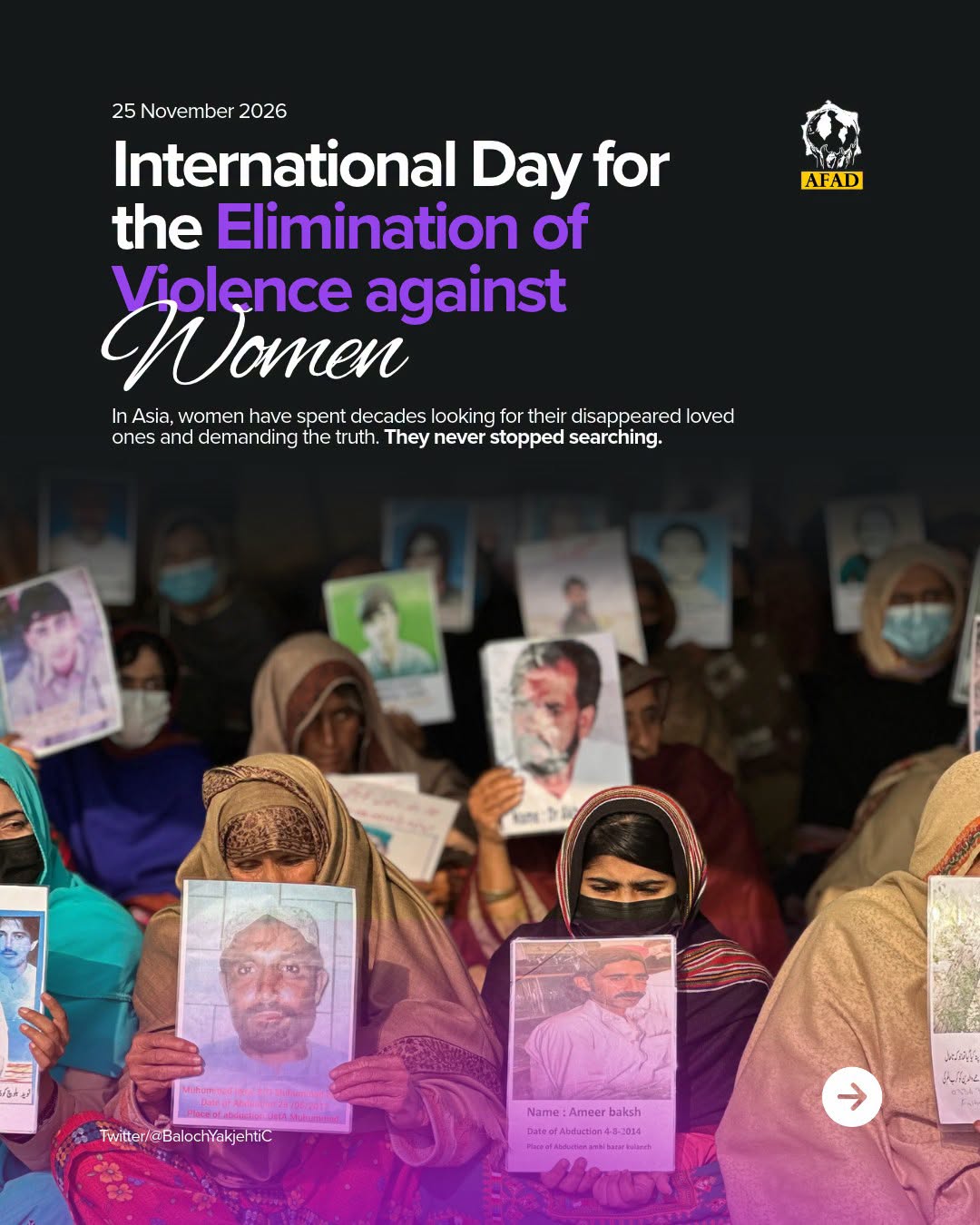
On 25 November 2026, the International Day for the Elimination of Violence against Women, AFAD and its member organizations sent this joint letter to the UN Special Rapporteur on violence against women and girls, the Working Group on Enforced or Involuntary Disappearances and the Committee on Enforced Disappearances. The letter was sent separately to each mechanism:
Ms. Reem Alsalem
Special Rapporteur on violence against women and girls, its causes and consequences
Email: hrc-sr-vaw@un.org
The Chair-Rapporteur and Members
Working Group on Enforced or Involuntary Disappearances
Email: hrc-wg-eid@un.org
The Chair and Members
Committee on Enforced Disappearances
Email: ohchr-ced@un.org
Re: Enforced disappearance and gender-based violence against women and girls in six Asian countries
Dear Ms. Alsalem, Members of the Working Group and Members of the Committee,
On the International Day for the Elimination of Violence against Women, the Asian Federation Against Involuntary Disappearances (AFAD) and the undersigned member organizations write to bring to your attention the violence experienced by women and girls in the families of disappeared persons in six Asian countries. We ask the Special Rapporteur and the Working Group to consider this information under their respective mandates and, where appropriate, to act jointly.
The International Convention for the Protection of All Persons from Enforced Disappearance requires States to settle the legal situation of relatives in matters of social welfare, finance, family law and property. The Working Group's General Comment on women affected by enforced disappearances recognizes that women suffer gender-based violence both as disappeared persons and as relatives of the disappeared. In September 2026, the Committee on Enforced Disappearances adopted General Comment No. 2, which recognizes women searchers as human rights defenders. We also write with the Special Rapporteur's forthcoming report on violence against girls in mind.
The Working Group has visited three of the six countries covered in this letter: Nepal in 2004, Pakistan in 2012 and Sri Lanka in 2015. The experiences described below show that the concerns raised in those reports remain unresolved for the women and girls in the families of the disappeared.
The information below comes from 13 interviews conducted in 2026 with women relatives of disappeared persons and staff of our member organizations, and from AFAD’s records of its projects with women relatives since 2024. The women are not named. Names, case details and supporting documents are held by our member organizations and can be shared with your offices in confidence, with the consent of the women concerned.
The pattern is the same in all six countries: officials meet women who search for their relatives with sexual harassment, threats or dismissal, while laws and administrative rules deny them control over property, documents and benefits unless they declare their relatives dead.
Bangladesh
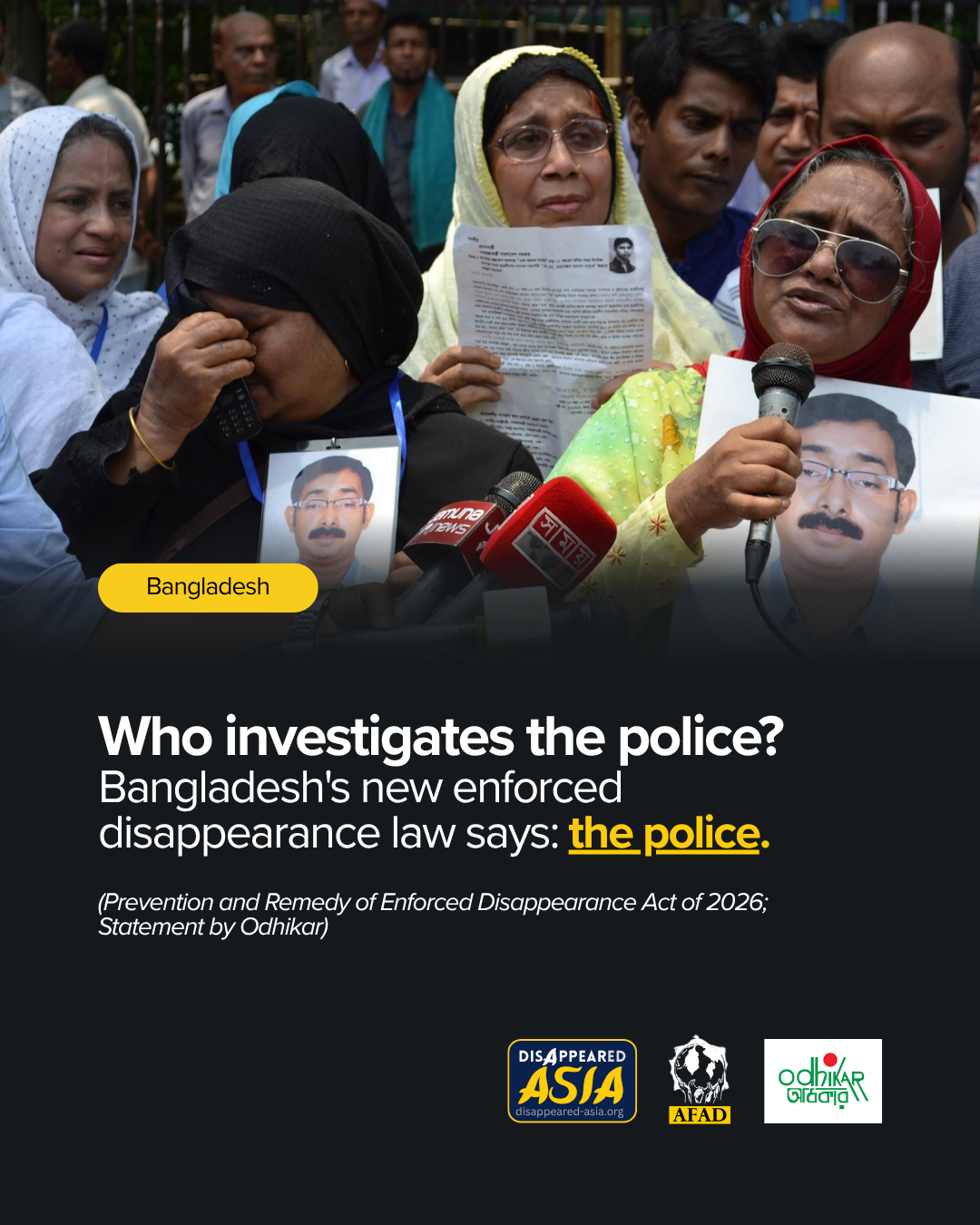
Period and alleged perpetrators. Odhikar documented enforced disappearances between 2009 and August 2024, which families attribute to the Rapid Action Battalion (RAB), the Detective Branch of police and military intelligence. Most of those taken were opposition activists. Some were released after August 2024, in one case after eight years in military intelligence custody. Most families still have no information. In January 2026, the Commission of Inquiry on Enforced Disappearances confirmed 1,569 cases and found that women and children had suffered disproportionate harm, including economic deprivation, social stigma and isolation.
Coerced statements. In 2022 and 2023, police and other law enforcement agencies came to the homes of families, in one case at around 1 or 2 a.m., and pressed mothers and wives to sign identical statements that their relative had left home voluntarily and had not been taken by RAB or any other agency. One wife refused; other parents signed.
Obstruction and surveillance. On 10 December 2023, at a Human Rights Day gathering at Shahbag in Dhaka, police surrounded a young woman speaking about her disappeared father, and the officer in charge of Shahbag police station took the microphone from her. Families report that state intelligence agencies, including the National Security Intelligence, monitored their phones and followed them.
Property, documents and housing. Wives and daughters have been unable to access bank accounts or property held in the disappeared person's name. The Enforced Disappearance Prevention and Redress Act, 2026, passed by Parliament on 6 September 2026, now lets spouses and dependants use the disappeared person’s property for maintenance, but a certificate of disappearance can be issued only after five years, and only to distribute the property among heirs. One young woman could not enroll at her chosen university because she could not access funds her father had set aside for her education. Mothers report being unable to arrange their daughters' marriages, and landlords refuse to rent to women living without husbands.
Indonesia
Period and context. KontraS works with families of persons disappeared in 1997 and 1998 and in earlier cases, including one from 1984. Indonesia has no legal status for disappeared persons. Letters issued by the National Commission on Human Rights recognize families as victims only for the purposes of witness status and psychosocial reparation.
Sexual exploitation by military officers. A woman whose husband was disappeared about three months after she gave birth went from one military detention center to another to find him. Military officers told her they would reveal where he was in exchange for sexual favours.
Harassment and intimidation of daughters. Daughters of persons disappeared in cases labelled “subversive” have been asked to undress during job interviews. After one father was disappeared in 1984, unknown persons repeatedly came to the family home until the family moved away. His daughter's scholarship was revoked, her education certificate labelled her “subversive”, and police harassed her when she applied for a clearance letter. Her younger sister, a human rights defender, was later followed by intelligence agents and had to move house several times. The human rights court that heard the case from 2003 ultimately acquitted all defendants.
Nepal
Period. Most cases date from the armed conflict of 1996 to 2006. Advocacy Forum holds legal documentation on more than 100 cases across all seven provinces.
Forced remarriage. In southwestern Nepal, a woman whose husband was disappeared was forced by her in-laws to marry his brother. Many wives were married young, and many husbands were taken from their bedrooms at night.
Death certificates as a condition for support. In Bardiya district, an Indigenous Tharu family whose father was disappeared about 25 years ago, when his daughter was four, had to obtain a death certificate to transfer land in his name and for the mother to receive a widow's allowance. Community members told the mother to stop searching and scrutinized her clothing and movements. Because citizenship by descent has required proof of the father's identity, daughters of disappeared men have also struggled to obtain citizenship certificates.
Court rulings. The Supreme Court has held that wives of disappeared persons may receive widow and single women's allowances without a death certificate, and in 2026 directed the government to adopt reparation laws and policies consistent with international standards. These rulings have yet to be implemented.
Pakistan
Scale. Defence of Human Rights (DHR) has recorded about 3,400 cases, and the Commission of Inquiry on Enforced Disappearances had received 10,636 cases by September 2025. Most disappeared persons are men, and their wives and mothers are usually the petitioners.
Sexual harassment at the Commission of Inquiry. DHR reports that a judge of the Commission made sexist remarks to the wife of a disappeared man, telling her she was too beautiful to be without a husband, and called women relatives to his home in the late evening. Families also report that the Commission discouraged them from approaching the High Court or bringing their own lawyers.
Threats and reprisals. DHR's women leaders have received anonymous letters at home containing obscene remarks, threats of character assassination and the message that their funeral was ready. Women relatives have been warned that they or their children could be abducted if they continue. Women who campaign online have been targeted with smear campaigns using their photographs.
Legal status and documents. Pakistani law has no legal status for a disappeared person. Banks and courts have required wives to accept that their husbands are dead before releasing accounts or property; one wife litigated for about four years before obtaining a succession certificate recording her husband as disappeared. When a father's national identity card expires, his children cannot obtain their own, which blocks passports and university admission. In joint households, a wife may need her father-in-law's or brother-in-law's permission to take legal action.
Philippines
Dismissal and blame by the armed forces and police. About 90% of the disappeared documented by FIND are men. At a 2024 regional dialogue, the regional commander of the Armed Forces of the Philippines responded to a mother searching for her son by suggesting that he may have “gone to the mountains”, and that a disappeared husband may have “another wife”. At a roundtable of agencies implementing the Anti-Enforced or Involuntary Disappearance Act, a police representative misstated the facts of a 2023 case until the unmarried partner of the disappeared man identified herself.
Failure to implement the law. A government psychosocial pilot programme ended after about a year, the Commission on Human Rights offers a one-time payment of PHP 10,000, and a Certificate of Absence bill has not been scheduled for a hearing.
Sri Lanka
Period. Disappearances occurred during the southern uprisings of 1971 and 1989 and the armed conflict in the north and east. Presidential commissions in the 1990s received about 27,600 complaints, but of their 26 recommendations only two were implemented: death certificates and small amounts of compensation. In 1989, a wife who went to a police station to report her husband's disappearance was chased out; her complaint was recorded incompletely the next day, and no action was taken until 1994. OHCHR has found that women at the forefront of the search have themselves faced harassment, intimidation, surveillance and arbitrary detention, and in 2025 the United Nations in Sri Lanka remained concerned about surveillance, threats and reprisals against families of the disappeared.
Death certificates and cases before the Working Group. The certificates issued in the 1990s record the cause of death as disappearance for more than one year, with the person presumed dead. Families accepted them because they needed documents for legal matters, and are now concerned that they may have been used to close cases before the Working Group, although the fate of the persons concerned was never established.
Reparations and ageing searchers. In 2024, about 3,800 families received a temporary allowance of Rs 200,000, but funds allocated in 2025 were not disbursed. Many mothers who have searched since 1989 are now between 75 and 90 years old, and many have died without learning what happened to their relatives.
Requests
Based on the above, we respectfully request the Special Rapporteur to:
1. Recognize in her reports and public statements that enforced disappearance is a continuing form of gender-based violence against women and girls in the families of the disappeared.
2. Consider communications to the Governments concerned, jointly with the Working Group, on the sexual exploitation, harassment, threats and coerced statements described above.
3. Address the situation of daughters of the disappeared, including barriers to citizenship, identity documents, education and marriage, in her report on violence against girls to the Human Rights Council at its 65th session.
4. Raise these concerns in country visits and dialogues with States in Asia.
We respectfully request the Working Group to:
1. Transmit the obstacles described in this letter to the Governments of Bangladesh, Indonesia, Nepal, Pakistan, the Philippines and Sri Lanka as general allegations, and seek their response.
2. Use its prompt intervention procedure where women relatives face intimidation or reprisals.
3. Confirm that a certificate presuming death, issued without establishing a person's fate and whereabouts, does not clarify a case under its methods of work, and review any cases from Sri Lanka closed on that basis.
4. Build on its General Comment on women affected by enforced disappearances in light of CED General Comment No. 2, and consider a joint statement with the Special Rapporteur on women searchers as human rights defenders.
5. Address the impact on women and girls in its study on militarization and enforced disappearances for the Human Rights Council at its 66th session.
6. Meet with women relatives from AFAD member organizations ahead of a forthcoming session.
We further ask both mechanisms to urge the States concerned to:
1. Establish a legal status of absence that allows relatives to manage property, bank accounts, guardianship, inheritance, identity documents and social benefits without declaring the disappeared person dead or waiting years for official recognition.
2. Investigate and prosecute sexual exploitation, harassment, threats and reprisals against women searchers, and protect them as human rights defenders.
3. Train police, armed forces, commissions of inquiry and courts to receive women relatives without discrimination, and provide effective channels for complaints against officials.
4. Provide gender-sensitive reparations, including long-term psychosocial support, livelihood assistance and educational support for children of the disappeared, designed with the women concerned.
5. Recognize unmarried partners and other members of a person's network of care as relatives and victims.
6. Establish the fate and whereabouts of all disappeared persons, hold those responsible to account, ratify the Convention where they have not yet done so (Indonesia, Nepal, Pakistan and the Philippines), and recognize the competence of the Committee on Enforced Disappearances.
We would welcome the opportunity to meet with you and to share case-specific information in confidence. For any questions or further information, please contact:
Natasha Mehmood
Regional Campaign Officer
Asian Federation Against Involuntary Disappearances (AFAD)
campaign.afad@protonmail.com
Sincerely yours,
Asian Federation Against Involuntary Disappearances (AFAD)
Odhikar, Bangladesh
Commission for the Disappeared and Victims of Violence (KontraS), Indonesia
Advocacy Forum (AF), Nepal
Defence of Human Rights (DHR), Pakistan
Families of Victims of Involuntary Disappearance (FIND), Philippines
Families of the Disappeared (FoD), Sri Lanka
Download official document here: Download official document (PDF)