
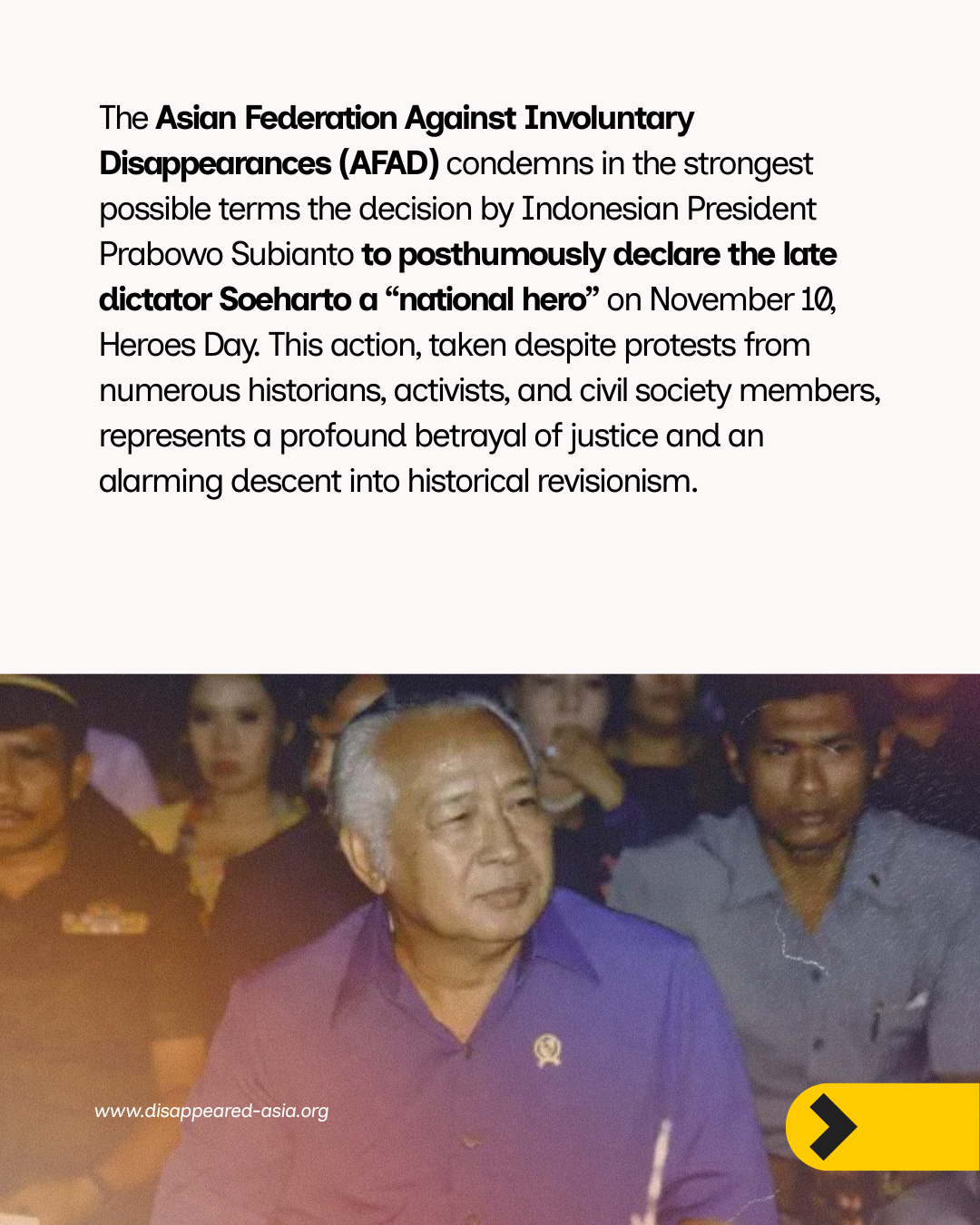
The Asian Federation Against Involuntary Disappearances (AFAD) condemns in the strongest possible terms the decision by Indonesian President Prabowo Subianto to posthumously declare the late dictator Soeharto a “national hero” on November 10, Heroes Day. This action, taken despite protests from numerous historians, activists, and civil society members, represents a profound betrayal of justice and an alarming descent into historical revisionism.
A military dictatorship and systematic human rights violations defined Soeharto's 32-year rule (1965–1998). During this period, the state implemented media censorship, tight restrictions on freedoms of assembly and association, a highly politicized judiciary, widespread torture, and numerous cases of enforced disappearances. His regime orchestrated massacres of alleged communists, resulting in the killing of more than half a million Indonesians, which has never been officially investigated. Additionally, Soeharto oversaw numerous war crimes in regions including Aceh, West Papua, the Moluccan islands, and Timor Leste (where an estimated 18,600 persons were killed or disappeared, including children forcibly taken away from their families), alongside running a notoriously corrupt regime that amassed billions in ill-gotten wealth.
AFAD stands in solidarity with our member organization in Indonesia, the Commission for the Disappeared and Victims of Violence (KontraS), which rightly stated that designating Soeharto a national hero is immoral and helps to normalize impunity. Soeharto never faced charges for the crimes he oversaw, and to date, there has been virtually no accountability for the widespread abuses committed under his command. Granting him this title facilitates the whitewashing and distortion of history, making it significantly harder for Indonesian authorities to secure justice for victims and their families.
This move eerily mirrors the injustice inflicted upon victims in the Philippines when Ferdinand Marcos Sr. was interred at the Libingan ng mga Bayani (Heroes' Cemetery) in 2016. Marcos’ regime, like Soeharto’s, was characterized as a "national trauma" marked by deceit, serious human rights abuses, and massive corruption. The Marcos burial, which was carried out swiftly and unexpectedly, was a powerful act of historical revisionism, reviving a false narrative that honored him as a soldier, statesman, and president while omitting or minimizing the atrocities committed under his authority.
Just as the Ocampo v. Enriquez decision in the Philippines legitimized a selective interpretation of history advocated by Marcos’s allies, Indonesia’s current action promotes a dangerous distortion of history and allows a false narrative to be propagated through state action. The valorization of figures like Soeharto and Marcos reopens the still-open wounds of tens of thousands of victims and their families.
By honoring perpetrators of mass atrocities, the Indonesian state subordinates the unmet needs of human rights victims, demanding that victims "move on and let this issue rest" in the interest of a false idea of national reconciliation. This disregard for accountability and acknowledgment perpetuates the historical interpretation of the repressors, deepening the national trauma endured by victims of involuntary disappearances, torture, and murder.
We recall that memory laws and state actions must be aimed at safeguarding the right to truth and preventing the development of revisionist arguments. The state has a duty to provide official acknowledgment of serious human rights violations, which is indispensable for the recovery of victims from their traumatic experiences.
AFAD urges the Indonesian government to rescind this designation and instead commit to the urgent need for accountability, recognition, and reparations for all victims of the systematic abuses committed under Soeharto’s rule. State actions must acknowledge the harm done, not promote the perpetrators who enabled impunity.