
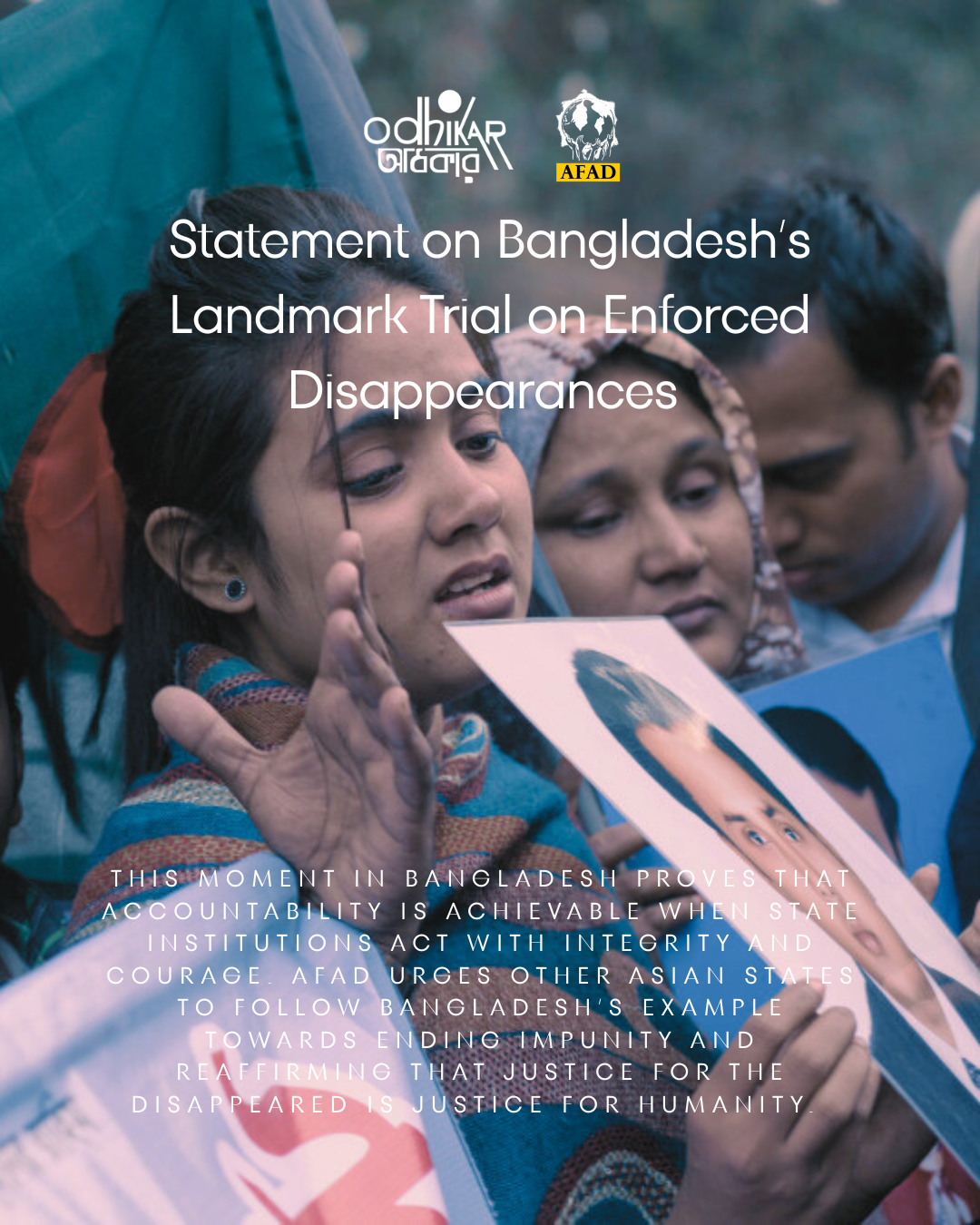
The Asian Federation Against Involuntary Disappearances (AFAD) welcomes the landmark step taken by the International Crimes Tribunal (ICT) of Bangladesh in remanding 15 high-ranking army officers, including five generals, on charges of enforced disappearances committed during the deposed Awami League regime, and for extrajudicial killings and torture linked to the 2024 uprising that toppled the former government. This represents the first time in Bangladesh’s history that formal charges have been brought for enforced disappearances and senior military officials face a civilian court.
According to official reports, all accused had previously served in military intelligence or the Rapid Action Battalion (RAB), a force sanctioned by the United States in 2021 for extrajudicial killings. A recommendation to disband RAB had also come from the Working Group on Enforced or Involuntary Disappearances in June 2025. The ICT also ordered public summons for the former prime minister, Sheikh Hasina, now in exile in India, in connection with related crimes against humanity.
AFAD views this judicial action as a critical moment for truth and accountability. As UN High Commissioner for Human Rights Volker Turk stated on 15th October 2025, the court process marks “an important step towards accountability” and “a significant moment for victims and their families”.
Independent estimates cited by the United Nations indicate that up to 1,400 people were killed during the July-August 2024 clashes, when security forces attempted to suppress protests. The Commission of Inquiry on Enforced Disappearances in Bangladesh has, to date, received 1900 complaints of enforced disappearances perpetrated during the regime of Sheikh Hasina between 2010 and 05 August 2024. For many families of the disappeared, these proceedings are the first sign that their calls for justice are being heard.
AFAD is pleased to note that Bangladesh acceded to the UN Convention for the Protection of All
Persons from Enforced Disappearance in August 2024 and to the Optional Protocol to the
Convention Against Torture (OPCAT) in July 2025. AFAD commends the resolve shown by Bangladesh’s Interim Government towards human rights protection; and the Tribunal for ensuring that crimes against humanity are duly tried and victims and family members get the justice they so rightly deserve. AFAD urges that due process, victim participation, and protection of witnesses remain central as the hearings continue.
As a regional federation of victim families and human-rights organizations across Asia, AFAD calls on all governments in the region:
- to enact domestic legislation criminalizing enforced disappearance and recognizing it as a continuing crime;
- to accede to and fully implement the International Convention for the Protection of All Persons from Enforced Disappearance (ICPPED);
- to pursue impartial investigations and judicial accountability regardless of official rank; and
- to ensure reparations and psychosocial support for affected families.
This moment in Bangladesh proves that accountability is achievable when state institutions act with integrity and courage. AFAD urges other Asian states to follow Bangladesh’s example towards ending impunity and reaffirming that justice for the disappeared is justice for humanity.
Click here to download: Statement on Bangladesh’s Landmark Trial on Enforced Disappearances