
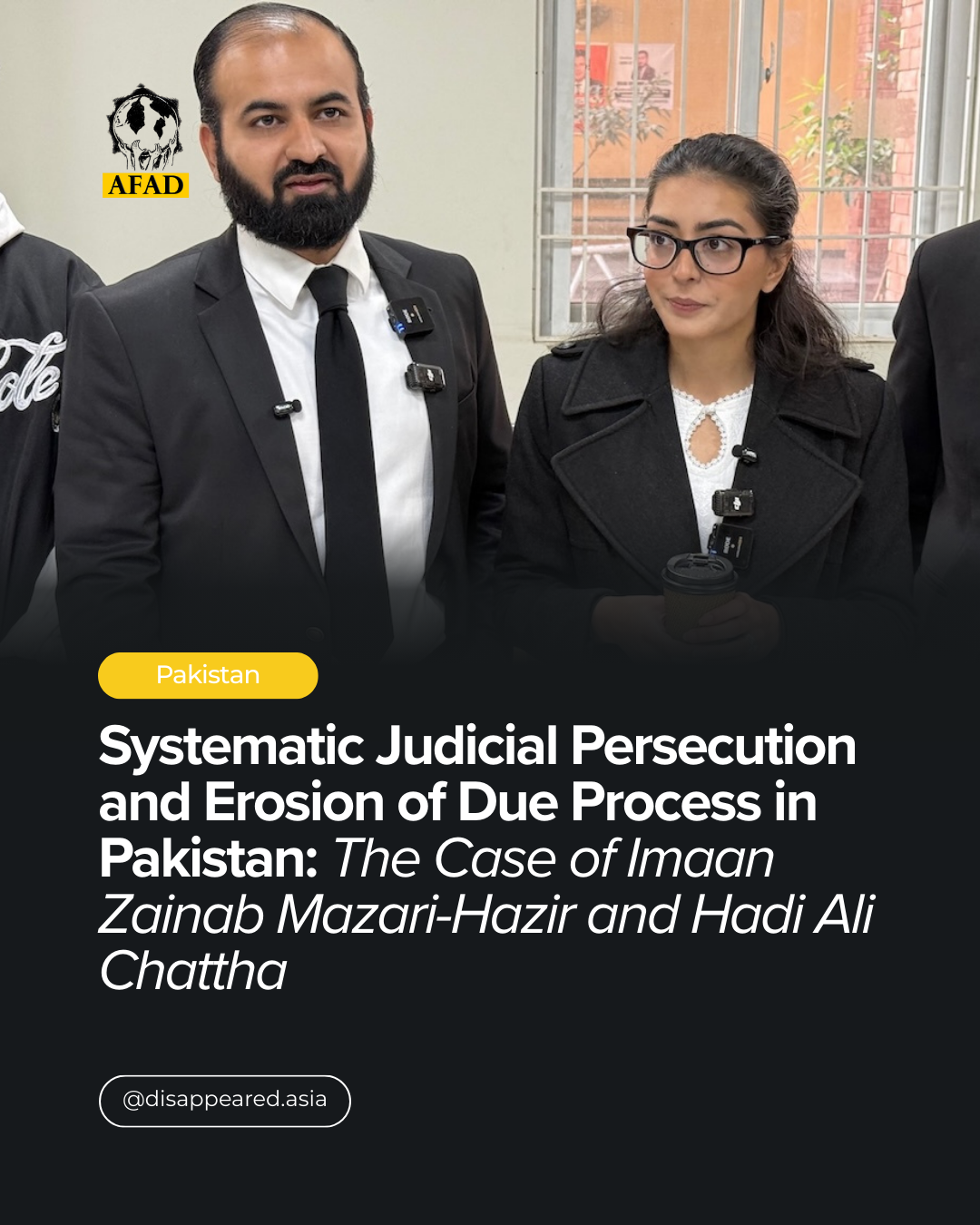
This statement addresses the grave deterioration of judicial independence and due process in Pakistan, as reflected in the case of Imaan Zainab Mazari-Hazir and Hadi Ali Chattha. At the epicenter of this crisis is the case of human rights lawyers Imaan Zainab Mazari-Hazir and Hadi Ali Chattha, whose arbitrary arrest on January 23, 2026, and subsequent 17-year prison sentence on January 24, 2026, represent a watershed moment for the rule of law in South Asia . This case is not merely a localized legal dispute; It demonstrates the use of criminal law to silence human rights defenders. The sentencing of Mazari and Chattha to a combined 17 years in prison was facilitated by the strategic deployment of the Prevention of Electronic Crimes Act (PECA), specifically as modified by the draconian 2025 amendments .
Imaan Zainab Mazari-Hazir is a human rights lawyer with over a decade of experience representing victims of enforced disappearances, extrajudicial killings, and racial profiling, particularly from Balochistan and Khyber Pakhtunkhwa. She has represented cases on behalf of the Defence of Human Rights (DHR), a member organization of the Asian Federation Against Involuntary Disappearances (AFAD). She has also provided pro bono legal defense to journalists facing state intimidation through her work with the Journalists Defense Committee. In recognition of her advocacy, Imaan Zainab Mazari-Hazir was honored by the World Expression Forum (WEXFO) with the WEXFO Young Inspiration Award, presented to a young voice whose work has made an extraordinary contribution to freedom of expression. Her husband and co-counsel, Hadi Ali Chattha, is a criminal law specialist known for defending individuals in false blasphemy cases and for his work with Justice Project Pakistan and the Asma Jahangir Legal Aid Cell, focusing on death-row prisoners and survivors of sexual violence. Together, their combined advocacy on state accountability and criminal justice reform has posed a significant challenge to abuses of state power . The trajectory of legal actions against Imaan Mazari and Hadi Ali Chattha suggests a long-term strategy of exhaustion.
Since 2022, they have been named in at least ten separate criminal complaints, ranging from sedition to terrorism, none of which had led to a conviction until the summary trial in 2026 .4 The resurfacing of a dormant July 2025 FIR linked to a Baloch Yakjehti Committee protest further entrenched a pattern of revolving arrests.1 On 23 January 2026, Imaan Mazari and Hadi Chattha were forcibly intercepted by Islamabad police while traveling in an IHC Bar Association vehicle to attend a court hearing. Witnesses report excessive force, including smashing car windows and arresting without a warrant or FIR, before taking them to an undisclosed location. They were later produced before an Anti-Terrorism Court and remanded for 14 days in a separate “scuffle” case, used to bypass an existing High Court bail order.1
The sentencing on January 24, 2026, occurred under conditions that fail any objective test of a fair trial. The trial court proceeded to a verdict despite a pending transfer application against Judge Majoka, which legally should have stayed the proceedings.1 Furthermore, the defenders were denied the right to cross-examine witnesses; instead, the court appointed a state-sponsored lawyer who admitted to receiving "dictated questions" from the prosecution.2 During her final appearance via video link, Imaan Mazari informed the court that she was being denied food and water in Adiala Jail, a claim that was ignored by the presiding judge.1
AFAD recognizes Imaan Mazari and Hadi Ali Chattha as essential guardians of the human rights framework in South Asia. Their work in representing the families of the disappeared and victims of custodial violence is a legitimate and necessary exercise of their professional duties. To criminalize their advocacy under the guise of "cyber-terrorism" and "anti-state activities" is a perversion of justice and a blatant attempt to silence the voices of the oppressed.
Appeal to the Government of Pakistan
AFAD demands the following immediate actions from the Government of Pakistan:
1. The government must immediately release Imaan Zainab Mazari-Hazir and Hadi Ali Chattha, quash their convictions, and dismiss all criminal cases pending against them, as these are clearly the result of politically motivated judicial harassment.
2. Conduct an independent and transparent inquiry into the use of undue force by the Islamabad police during the arrest of the defenders on January 23, 2026, and hold the responsible officers accountable.
3. Pending their release, jail authorities must guarantee the physical and mental integrity
of the detainees, ensuring immediate access to legal counsel, family members, and specialized medical care. The denial of food and water in detention must be investigated as an act of torture.
4. The government must move to repeal the 2025 amendments to the Prevention of Electronic Crimes Act (PECA) and overhaul the original 2016 Act to bring it in line with international standards on freedom of expression and due process.
5. Pakistan must immediately sign and ratify the International Convention for the Protection of All Persons from Enforced Disappearance (ICPPED) and domesticate its provisions to ensure that no state actor remains above the law.
6. Repeal the provisions of the 27th Constitutional Amendment that allow for the arbitrary transfer of judges and grant criminal immunity to military officers, thereby restoring the Supreme Court's constitutional role as a check on executive power.
AFAD stands in unwavering solidarity with Imaan Mazari, Hadi Ali Chattha, and the entire human rights community in Pakistan. We will continue to document these violations and mobilize the international community to ensure that justice is not only sought but delivered. The state cannot silence the truth by imprisoning the advocates of the disappeared. Memory is our strength, and justice remains our demand.