 Asian Federation Against

What's Happening
AFAD@15: An Arduous Journey Under a Crystal Clear Sky

AFAD 15th Anniversary Statement
4 June 2013 - A decade and a half have passed since the founding of the Asian Federation Against Involuntary Disappearances (AFAD). Many Asian governments continue the practice of making people disappear while past cases remain unresolved. While they fail to hold the perpetrators accountable, victims and their families continue to suffer from this abominable scourge, which violates a number of human rights. Much as it wants itself to be rendered irrelevant, AFAD remains to be relevant.
The birth of AFAD had given voice to the voiceless, power to the powerless and presence to the disappeared in the Asian region. It has provided flesh and blood to solidarity which endeavors to transform shared aspirations into common actions towards a unified vision.
Onward to Becoming Champions For the Disappeared: ICAED’s Challenge to All UN Member-States
 It has been more than 32 years since FEDEFAM, the Latin American Federation of Associations of Relatives of Disappeared-Detainees (FEDEFAM), initiated the commemoration of the International Week of the Disappeared every last week of May. The FEDEFAM, in its first Congress in San Jose, Costa Rica in 1981, envisioned this week as a venue for intensified campaign for justice and peace for all desaparecidos and their families.
As the International Coalition Against Enforced Disappearances (ICAED) continues to adopt this endeavor led by families’ organizations for the disappeared in different parts of the world, we also exclaim the need for a unified duty to accord the rights of every citizen not to be subjected to enforced disappearance. The Coalition adheres to believe that the foremost solution to ensure that the number of cases documented and reported will not increase and for cases of the past to be resolved is for all states to accede to the International Convention for the Protection of All Persons from Enforced Disappearance (the Convention).
AFAD Remembers and Honors the Men, Women and Children Victims of Enforced Disappearance in Asia and The World

On the 32nd year of the commemoration of the International Week of the Disappeared, the Asian Federation Against Involuntary Disappearances (AFAD) joins the families and friends of victims of enforced disappearance in remembering, paying tribute and restoring the dignity of the men, women and children who were made to disappear in Asia and the rest of the world.
Clarion Call of Families of Desaparecidos: Repair Damage Done, Restitute Honor and Dignity
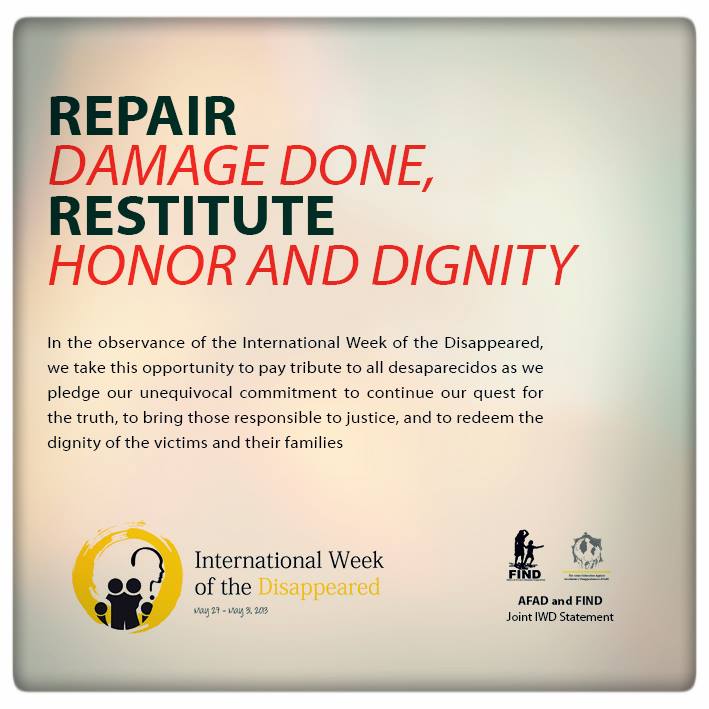 AFAD and FIND Joint Statement on the International Week of the Disappeared
Every last week of May, organizations of the families of the disappeared and human rights advocates worldwide commemorate the International Week of the Disappeared (IWD) following the Latin American tradition which successfully brought to international attention the global phenomenon of enforced disappearance and the imperative for a global response.
Enforced disappearance is a continuing affront to human dignity, civil rights and liberties as well as violations of economic, social and cultural rights. It continues to inflict untold sufferings not only on victims but also on their families. It is committed when a person is deprived of liberty by the state or agents of the state, and information on the whereabouts of the missing is concealed or denied.